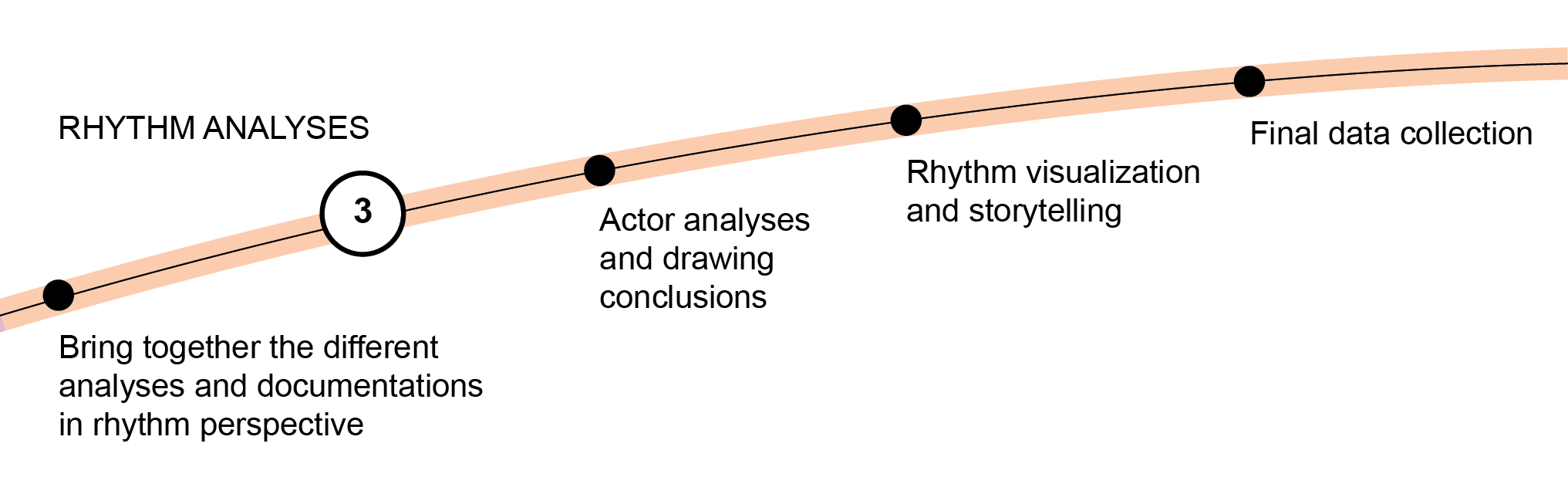
The rhythms related to the social issue are explored in detail and further data are collected regarding the urban context. Such detail enables the rhythm analysis to function as a boundary object in the next step, structuring the conversation of the stakeholders around accurate facts.
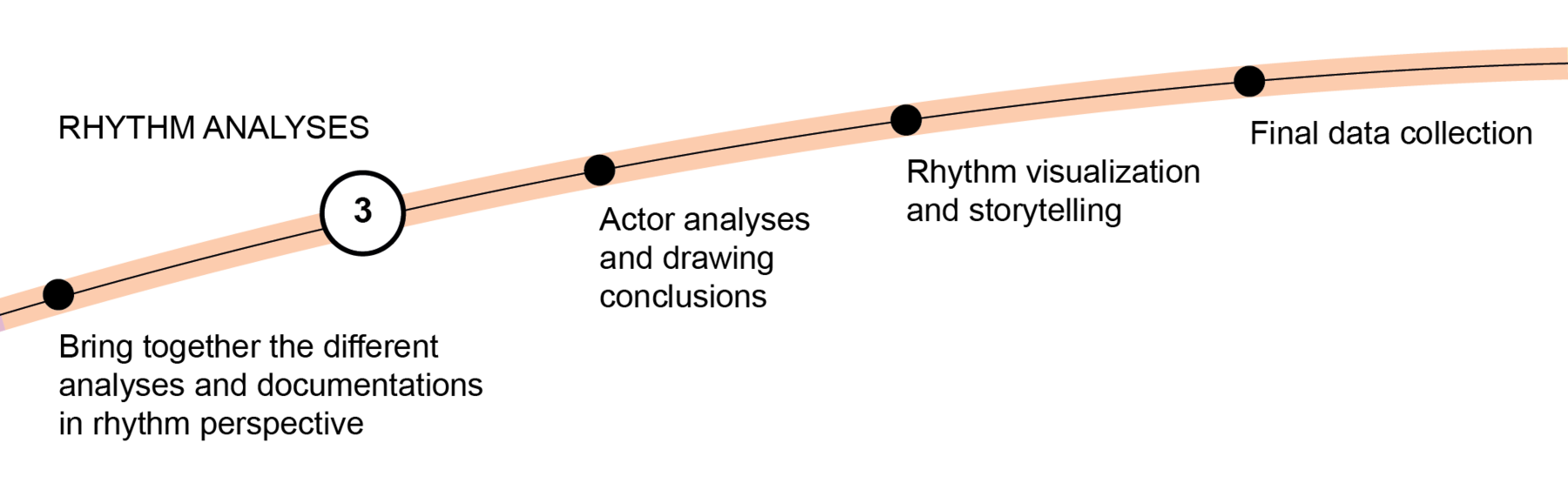
Actor analyses and drawing conclusions: Proceeding to the Problem Definition phase of the Intervention Cycle, the research team explores the actors that play a main role in the social issue in more detail. This is done by choosing target groups and analysing their daily rhythms. Based on the chosen target groups, personas may be created, which allow the detailed documentation of personal rhythms. Bringing together the information from the interviews and site research, the possible activities the target groups carry out during the day are listed with specific hours.
Rhythm visualization and storytelling: In this step, the findings of the spatial and temporal analyses of the urban context are visualised. Being as visual as possible from the beginning in the other documentations helps to communicate the findings and see the rhythm aspect immediately. The time frame of the visualization may vary based on the research question as daily, weekly or monthly rhythm visualisations. Based on the visualisation of different rhythms, scenarios are created that explain the social issue from different rhythm perspectives.
Final data collection: At this stage, the researcher needs specific answers from the interviews on other ways of data collection. Having identified actors whose daily life patterns are important for research, the researcher can go directly to the people who are part of the chosen actor groups with pre-defined questions, or direct these questions to organisations or social groups that the actor group is associated with. At the same time, additional datasets (such as municipality maps) can be viewed in order to enrich the spatial and temporal analyses.
Making rhythm analyses into a boundary object: In this final step of bringing the social issue into the rhythm domain, the results are critically combined and compared, based on the initial research question. This can be done by comparing the rhythms of different people or persona’s with the rhythms of selected areas in the neighbourhood, different rhythms of the neighbourhood, or altogether in different time frames. Representing these comparisons visually will make it possible for the stakeholders to collectively reflect on the rhythms that affect the social issue and make conclusions regarding the rhythm domain.