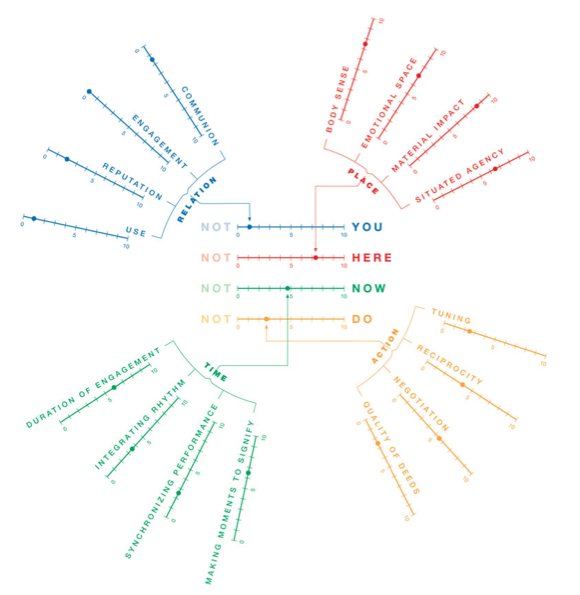
In the construction of witnessing as a process of interaction, with or without the use of technology, each of the four dimensions of the YUTPA framework is defined by values of specific factors, which influence the making trade-offs significantly out of which presence and trust emerge. In the interviews with the experts, each of the four dimensions— time, place, action, relation—is addressed specifically in relation to presence and trust. The challenge is to formulate perceptions and understandings that seem to be mundane because technology deeply invades personal lives. As result, in the analysis, in each dimension, factors that affect the trade-off for presence and trust are identified (see illustration).
Between the value and nature of factors in each of the four dimensions, trade-offs are made. Trade-offs define how peo- ple perform their presence and engage with potential trust. Trade-offs are the result of negotiation between perception, expectation and intention. Together with designers, Chris Vermaas and Chin-Lien Chen visualization of trade-offs has been explored. Results are shown below.
5 Configuring trust through reciprocity and granularity in Witnessed Presence
-
article_academia
Time is the beholder of trust
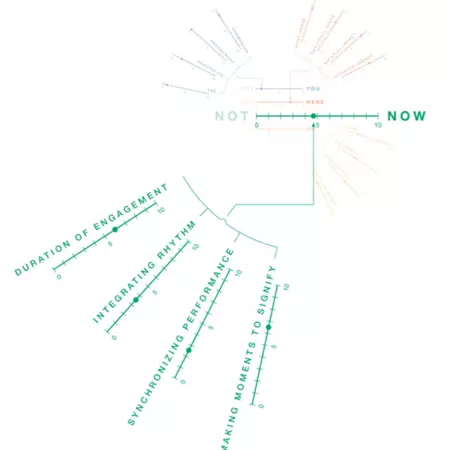
Where before place was often the beholder of trust, in online communication, time has become the…
-
Collection
Place is defined by engagement
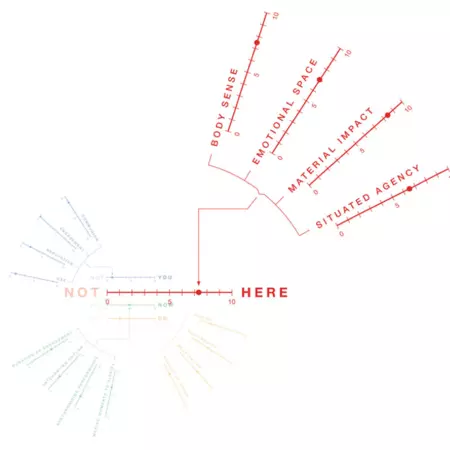
One of the most remarkable phenomena that emerged from the large-scale use of the Internet is the…
-
Collection
Relation: patterns in granularities of interaction
In different social sciences, medicine and the humanities, a variety of concepts are used to…
-
Collection
Action and reciprocity: trust sets the scene
Action is the final dimension to be discussed in this paper. The interviews showed that action is…