 Tatiana Armijos Moya
BIOMIMICRY: A SUSTAINABLE TOOL
KEY WORDS: Biomimicry, Sustainability, Nature
According the biologist Janine M. Benyus, biomimicry can be defined as imitating or taking inspiration from nature’s forms and processes to solve problems for humans. Indeed, she claims that it is necessary to imitate nature to ensure a more sustainable future. Regarding all these factors it is possible to say that biomimicry introduces an era based not on what people can extract from the natural world, but on what people can learn from it. Therefore, biomimicry is an innovation method that seeks sustainable solutions by emulating nature’s time-tested patterns and strategies. (Benyus, 2002) (BiomimicryGroup, 2014)
In fact, nature has been tested strategies for 3.8 billion years and biomimicry helps study the successful strategies of the survivors and allow humans to apply them within innovative sustainable designs. For instance, engineers from firm Arup, led by Mick Pearce, sought inspiration for the ventilation design from termite mounds in order to design the Eastgate Complex in Zimbabwe; thus, generating passive cooling buildings.
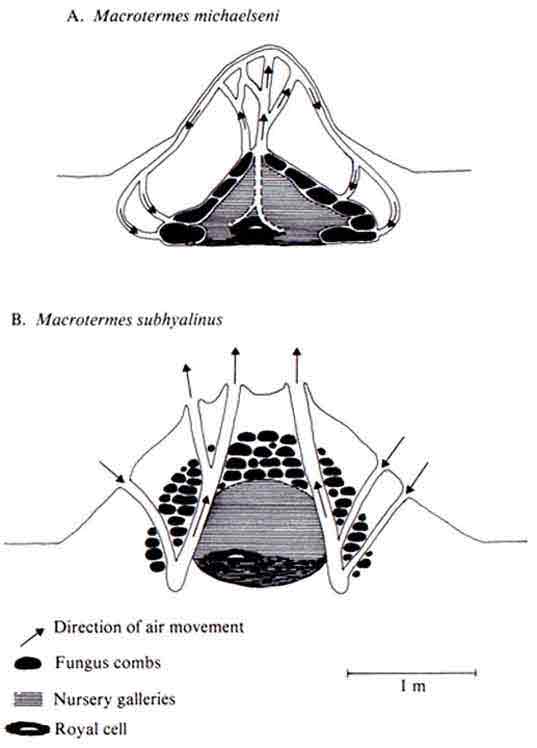
People generally think of termites as destroying buildings, not helping design or improve them. But the Eastgate Building, an office complex in Harare, Zimbabwe, has an air conditioning system based on the self-cooling mounds of Macrotermes michaelseni, termites that maintain the temperature inside their nest to within one degree, day and night (while the temperatures outside swing from 42 °C to 3 °C).
Actually, the operation of buildings represents 40% of all the energy used by humanity, so learning how to design them to be more sustainable is vitally important. Designed by architect Mick Pearce, Eastgate uses 90% percent less energy for ventilation than conventional buildings its size, and has already saved the building owners over $3.5 million dollars in air conditioning costs.
Strategy: Biologizing the problem
Problem definition:
Creating a passive cooling system for a 324 000 square-foot commercial, office and shopping complex located in Zimbabwe, based on natural principles.
Reframe the problem: ‘biologizing’ the problem:
Biological analogy: Termite mounds
Biological solution search:
Termites build their mounds using zero-waste construction methods, employing solar-powered air conditioning and developing a sustainable agriculture system. Actually, the forms of the mounds change according to the location; however, regarding scale of those mounds they can be compared with skyscrapers for human beings. Furthermore, the forms of termite mounds represent elaborate systems for thermal control in order to generate optimum thermal conditions for egg-laying fungus farming.(Pawlyn, 2011) (Turner & Soar, 2008)
Define the biological solution:
The mound created by compass termites (Amitermes meridionalis) in Western Australia.
Principle extraction:
The mound created by compass termites has the shape of a flattened almond with a long north-south axis that catches the light during the day and release heat during the night. Besides, many ventilation tubes are located within the walls. What is more, termites are able to open and close a series of heating and cooling vents throughout the walls of mound during the day. Hence, when interior temperature rises too high, vents can be opened; thus, rising warm air by stack effect. (Pawlyn, 2011) (Doan, 2012)
Principle application:
The solution was a passive-cooling structure with specially designed hooded windows, variable thickness walls and light coloured paints to reduce heat absorption. The construction is based on a heavy masonry construction, which uses an external shading system that helps to minimize the solar heat gain. Furthermore the cool air is circulated into large floor voids that have a labyrinth of precast concrete elements that maximize heat transfer by having a large surface area. What is more, 48 masonry chimneys are used in order to provide adequate ventilation that keeps the interior temperature between 21ºC and 25ºC, while the outside temperature range between 5ºC and 33ºC. (Pawlyn, 2011) (Turner & Soar, 2008)
Bibliography
BiomimicryGroup. (2014). Biomimicry. Retrieved November 21, 2014, from Biomimicry 3.8: http://biomimicry.net/about/biomimicry/
Doan, A. (2012, November 29). BIOMIMETIC ARCHITECTURE: Green Building in Zimbabwe Modeled After Termite Mounds| Inhabitat - Sustainable Design Innovation, Eco Architecture, Green Building . Retrieved November 21, 2014, from Inhabitat: design will save the world: http://inhabitat.com/building-modelled-on-termites-eastgate-centre-in-zimbabwe/
Pawlyn, M. (2011). Biomimicry in Architecture. London: RIBA Publishing.
Benyus, J. M. (2002). Biomimicry: Innovation Inspired by Nature. New York: HarperCollins Publishers.
Turner, J. S., & Soar, R. (2008). Beyond biomimicry: What termites can tell us about realizing the living building. First International Conference on Industrialized, Intelligent Construction (I3CON), Loughborough University , 1-18.
Geplaatst .