Pinchevski (2005) begins his book on the ethics of communication by reflecting on William Harben’s (1892) short story “In the Year Ten Thousand.” In this story, a father takes his son to a museum where they examine a relic from the “Dark Ages,” a book published circa 2000. This is the first time his son has seen a book. “I cannot see what people could have wanted with them,” the son says, “they seem to be useless” (p. 1). The father, smiling at his son, explains that “eight thousand years ago human beings communicated their thoughts to one another by making sounds with their tongues, and not by mind-reading, as you and I do.” Peering into the book, the father points to an image. “Pictures then, as you see, were very crude,” he says, “Art was in its cradle.” The father explains that primitive man did not know how to “throw light and darkness into space in the necessary variations” as they do today to make objects with “every appearance of life” but used coarser materials such as oil paint on canvas. The boy, bending down to look “admiringly for a few minutes,” recoils in disgust. “These men have awful faces,” he exclaims, “They all have huge mouths and frightfully heavy jaws.” The son is horrified when told that in the Dark Ages human beings ate flesh. Listening with the boy to the father’s history lesson, the reader learns that in the year 4051 “thought-telegraphy” was discovered and grew to the point that by the year 5000 only the uneducated classes spoke using words. The adoption of mind reading eventually transforms society beyond all expectations. “Slowly it killed evil,” the father says, for “If a man had an evil thought, it was read in his heart, and he was not allowed to keep it” (p. 3). The transformations culminate in the year 6021 when the entire world agrees to live in harmony and unity “being drawn together in brotherly love by constant exchange of thought.” The rest of the father’s lecture extols the technological advances that follow in the wake of universal peace, including the ability to traverse the world in less than twenty-four hours and to observe its daily rotation from an airship located at a great height. “Fancy what must have been that [inventor’s] feelings,” the father declares, “when he stood in space and saw the earth for the first time whirling beneath him!” Leaving the museum, the father and son pause for a moment to reflect on immortality as they listen to the music of the heavenly spheres. Life and death (“I came here last evening to listen to the musical struggle between the light of dying day and that of the coming stars,” the father tells his son) and the need for meaning (“What does life lead to?” the son asks) persist even in this world, but immortality, the father concludes, “is increasing happiness for all time” and “love immortal” (p. 3).
Harben’s depiction of future technologies that foreshadow 3-D holography, space explorations, and high-speed air travel, amazing as they are, is not, for Pinchevski, what makes this nineteenth century science fiction tale so prescient. Harben’s most remarkable insight is the causal link he draws between communication and society. What he has managed to grasp and express is the distinctly modern conviction that improving the means of communication improves human relationships. Pinchevski cites a number of twentieth century scholars who share the same conviction. One critic, for instance, is quoted as saying, “True communication—the delivery of a signal, verbal or nonverbal, conveying to the recipient an approximation of the message and a measure of its intent—would seem in our time to have its best chance ever for reduction of human tensions and enhancement of human peace” (Ardrey 1974, p. 154). And Pinchevski recalls this passage by McLuhan (1964) that anticipates an evolution in communication that closely approximates Harben’s vision for the year 6021: “The next logical step would seem to be, not to translate, but to by-pass language in favor of a general cosmic consciousness … the condition of speechlessness that could confer a perpetuity of collective harmony and peace” (McLuhan 1964, p. 80). Pinchevski claims that the implicit ethical assumption “to a greater or lesser extent, in accounts [of communication] as divergent as communication theory, modern philosophy, political thought, social psychology and psychiatry” (p. 6) agrees with Harben that improving methods of communication fosters understanding between people and leads to more congenial relationships with others. Consequently, communication studies have been intent on improving communication skills, developing better technologies, and, in general, exploring how problems in communication can be overcome.
According to Pinchevski, the various forms of communication—from speech to telephone to the Internet— could be viewed, along the evolutionary lines of the Harben’s father’s history lesson, as a linear progression, where each new form rectifies the shortcomings of those preceding it. Books preserve speech, the telegraph sends messages across vast distances faster than couriers, radio combines speech signals with air waves for wireless transmission, television adds visuals, and the Internet enables interactivity. With mediation increasingly becoming more immediate and ethereal, the trajectory of such a progression does indeed seem to converge on something like Harben’s “thought-telegraphy” or McLuhan’s cosmic consciousness. Yet, as Pinchevski observes, “no matter how much effort one puts into overcoming problems of communication—misunderstandings, vagueness, inconsistency, loss for words, misconstruing intended meaning, impasse and breakdown—the more there seems to be ahead” (p. 5). He goes on to note the paradoxical proliferation of these problems in the advancement of communication technologies.
The trajectory of communication technology, originating in speech and culminating in cosmic consciousness, can also be viewed from a radically different perspective—that of Kristeva’s theory of signification. In the process of signification, where “word” and “flesh” meet, the bodily drives—the “desire noise” of the semiotic—is an essential component of signification (Kristeva 1983/1987, 1985/1987, p. 15). The modern concern with removing whatever impedes transparency in communication threatens the semiotic, as the voiceless utopia envisioned by both Harben and McLuhan discloses. In reading Harben’s story against Kristeva, most striking is the view of communication, and of the human, that denigrates the body while elevating a mind that is completely translucent and transparent. In the communion of minds enjoying cosmic consciousness, there is no darkness, no unconscious, no division.[39] From a Kristevian perspective, the linear progression of communication technologies might be read more accurately as a desire for an intrauterine bliss that is converging less on a revolutionary transcendence[40] than on a regressive autism that is dismantling the darkroom. Kristeva (1997/2002) writes, for instance, that “The conditions of modern lives—with the primacy of technology, image, speed, and so forth, inducing stress and depression—have a tendency to reduce psychical space and to abolish the faculty of representation. Psychical curiosity yields before the exigencies of so-called efficiency” (p. 11). In furthering the “tendential severance” (Beardsworth 2004) of the symbolic and semiotic, developments in communication technologies are fostering the “new maladies of the soul” (Kristeva 1997/2002), rather than, as Harben (1892) puts it, “increasing happiness for all time” (p. 3).
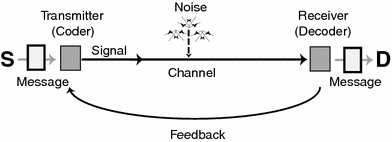
In Language the Unknown, Kristeva (1981/1989) expresses the following skepticism towards communication theory: “If given a dominant position in the approach to language,” she writes, “[a communication theory] would risk masking any problematic that concerns linguistic formation and production.” Kristeva elaborates, “The formation and production in question are those of the speaking subject and of communicated signification, which are nonanalyzable constants in that theory of communication” (p. 7). To understand how this plays out in communication technologies, let us begin by considering her concern in light of Shannon’s (1948, 1949) model of communication (see Fig. 1), often referred to as the “mother of all models” (Woods and Hollnagel 2005) because of its broad impact not only on telecommunications but also on such diverse fields as psychology, philosophy, engineering, computer science, linguistics, biology, critical theory, and economics.
Shannon’s model reduces communication to the fundamental problem of transmitting a message from a source to a destination in such a way that the source message matches, despite the inevitable injection of interference and disruptive noise, the one that is received at the destination. The strength of Shannon’s theory stems from its focus on communication signals and a mathematical definition of information that “relates not so much to what you do say, as to what you could say. That is, information is a measure of one’s freedom of choice when one selects a message” (Shannon and Weaver 1949, pp. 8–9). At this level of abstraction, the model has no need to distinguish a source or a destination that is human from that which is not, and the meaning embedded in the message is of no significance as well: “These semantic aspects of communication are irrelevant to the engineering problem. The significant aspect is that the actual message is one selected from a set of possible messages” (p. 31). In other words, what matters are the statistical properties of the set. The set of messages could be of any sort, including, for example, instructions that guide a missile to its target. By rendering the speaking subject and signification irrelevant, Shannon’s model certainly bypasses “any problematic” concerning “linguistic formation and production,” just as Kristeva claims is the case with communication theories generally.
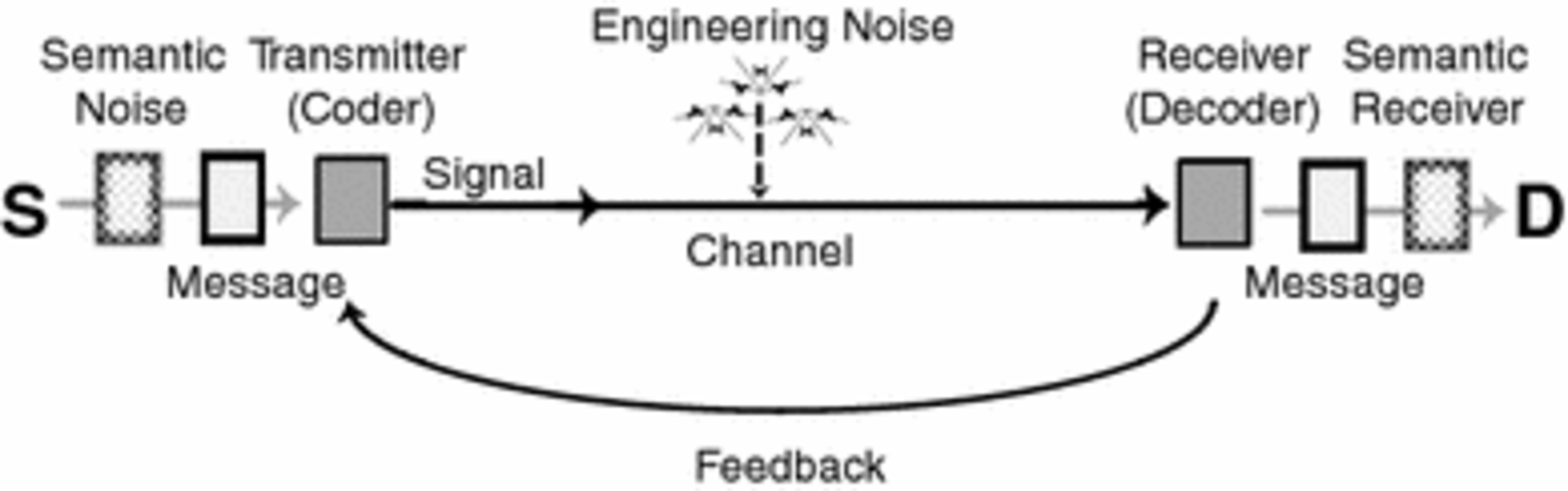
Weaver (1964), who provides a nonmathematical introduction to Shannon’s reprint of The Mathematical Theory of Communication (1948), recognizes, however, that with the transmission of information between human beings comes a need to address more specifically the semantic layer of communication. Weaver believes this would necessitate a consideration of “the statistical characteristics of the destination” (p. 26), along with those of the source, and would introduce at least two additions to Shannon’s basic model (see Fig. 2). The first would be a semantic receiver that would decode the semantic content according to the capacity of the destination, or an audience, to understand the meaning in the message. Furthermore, it would subtract the “semantic noise,” the second addition in the model, that the source inadvertently imposes on the signal. Weaver defines semantic noise as composed of “the perturbations or distortions of meaning which are not intended by the source but which inescapably affect the destination” (p. 26). Weaver concedes, without elaborating, that the addition of “semantic noise” might produce additional meaning that is of value, unlike the undesirable noise in Shannon’s model, which Weaver renames “engineering noise” (p. 26).
After discussing semantics, Weaver admits that Shannon’s theory “at first seems disappointing and bizarre—disappointing because it has nothing to do with meaning, and bizarre because it deals not with a single message” but with the statistical properties of ensembles of messages (p. 26). But he assures the reader that this is a temporary reaction to a theory that “has so penetratingly cleared the air that one is now, perhaps for the first time, ready for a real theory of meaning” (p. 26). Even though his reflections on semantics suggest the model is in need of expansion, Weaver is careful to point out that incorporating semantics does not require any major revisions. Moreover, he finds a certain solace in a theory of communication that is “just like a very proper and discreet girl accepting your telegram. She pays no attention to meaning, whether it be sad, or joyous, or embarrassing. But she must be prepared to deal with all that come to her desk” (p. 26). Although such a passage is ripe for all sorts of psychoanalytical interpretations, what is striking from the perspective of this essay is how closely Weaver’s depiction of the “engineering” theory of communication, as a discreet and accepting girl, resembles an important feature of the psychoanalytic stance: the analyst’s struggle to control her affective responses so that they do not interrupt the patient’s processes. The difference is that no one is contained in Shannon’s model. Ideal communication is the replication of a message from a source to a destination, neither of which need be human, and Weaver scrambles to obtain something more from the model—is there not a hint of an interpretive capacity in the semantic receiver?[41]—than a mere reflection of the intended outcome.
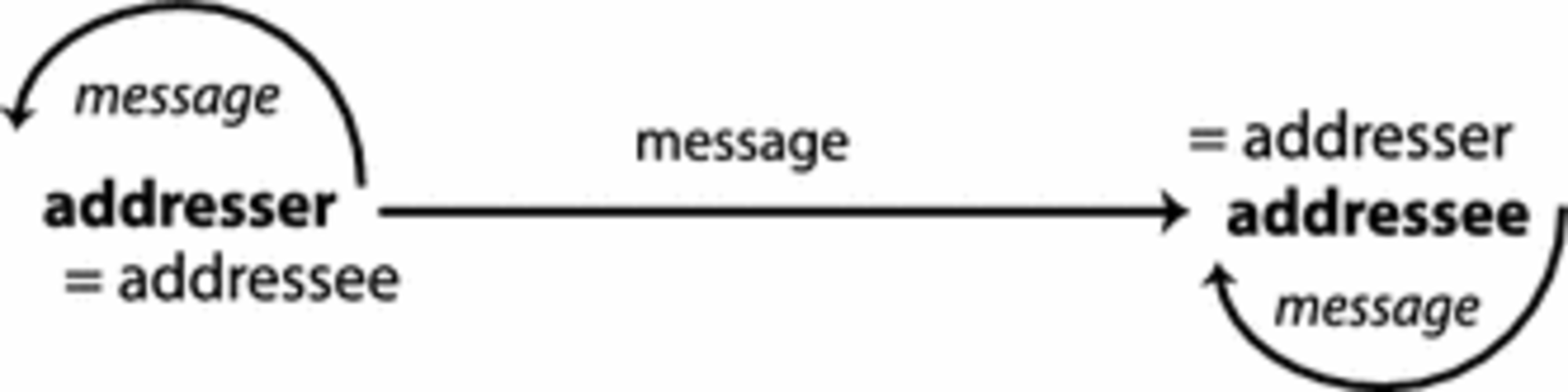
Granting that communication between human beings can be considered along the lines of a basic transmission model, that is, as a message passed from an addresser to an addressee, Kristeva (1981/1989) is concerned to point out that the path of transmission is more involved, even at this basic level, than such models would allow. For one, since the speaking subject is capable of both sending and receiving messages (see Fig. 3), any message “intended for the other is, in a sense, first intended for the one who is speaking: whence it follows that to speak is to speak to oneself”; moreover, the addresser cannot say “anything he cannot decipher.” Similarly, the addressee “deciphers the message only to the extent that he can say what he hears/understands” (p. 8). The path of the message, in other words, inscribes an internal circuit, within both the addresser and the addressee, that is bound up with semantics (one’s semantic capacity) and that “leads us into the complex realm of the subject, his constitution in relation to his other, the way in which he internalizes this other and is confused with him” (p. 8).
To elaborate, if it is the case that “each speaking subject … is capable of emitting a message and deciphering it at the same time” (p. 8), then these dual activities in themselves imply a mind that is divided, at least into a listening part and a speaking part. Moreover, in speaking to himself while simultaneously communicating to the addressee, the addresser is listening not only to and for himself but also to and for some other. Kristeva, in her discussion of psychoanalytic language in Language, the Unknown, notes how “every discourse is destined for an other” (p. 267), and she immediately quotes Lacan (1977) as saying, “there is no speech without a reply, even if it is met only with silence, provided it has an auditor” (p. 40). Thus, in speaking and listening to himself, the addresser is also speaking and listening to some other that is neither solely himself nor solely the addressee per se, but something he imagines or imposes on the other. The confusion between addresser and addressee would thus entail something like the relational ambiguities posited by psychoanalysis in transference/countertransference and in projection/introjection. This ambiguity of addresser/addressee not only reformulates the unconscious/conscious distinction but also suggests a subjectivity that continuously recreates itself in relation to others, as Kristeva points out in quoting Benveniste (1939/1971): “The subject’s language provides the instrument of a discourse in which his personality is released and creates itself, reaches out to the other, and makes itself be recognized by him” (p. 67).
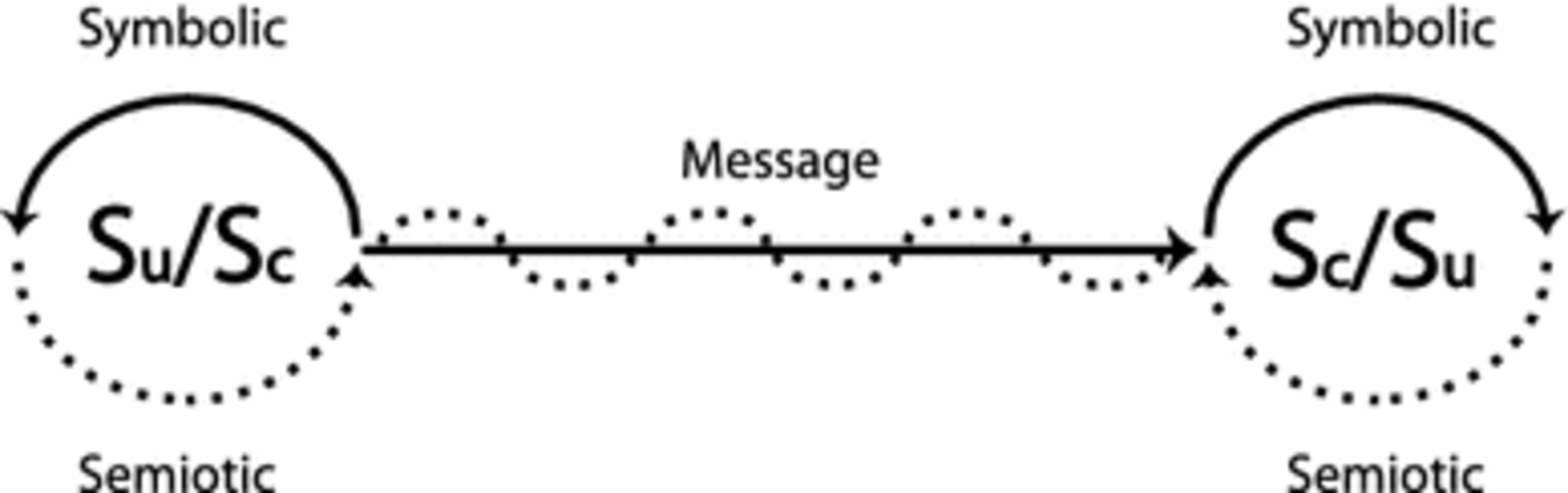
Kristeva’s expanded circuit in Fig. 3 that “leads us into the complex realm of the subject” (Kristeva 1981/1989, p. 8) could thus be redrawn, as in Fig. 4, for example, to represent the unconscious/conscious split in the subject or, more specifically, her conception of the subject as a speaking being that is constituted by its signifying practice: “The subject never is,” Kristeva (1974/1984) writes, “The subject is only the signifying process and he appears only as a signifying practice” (p. 215). As noted in Sect. 3, this makes the speaking subject, for Kristeva, “an impossible unity” (p. 118) that is “always both semiotic and symbolic” (p. 24).
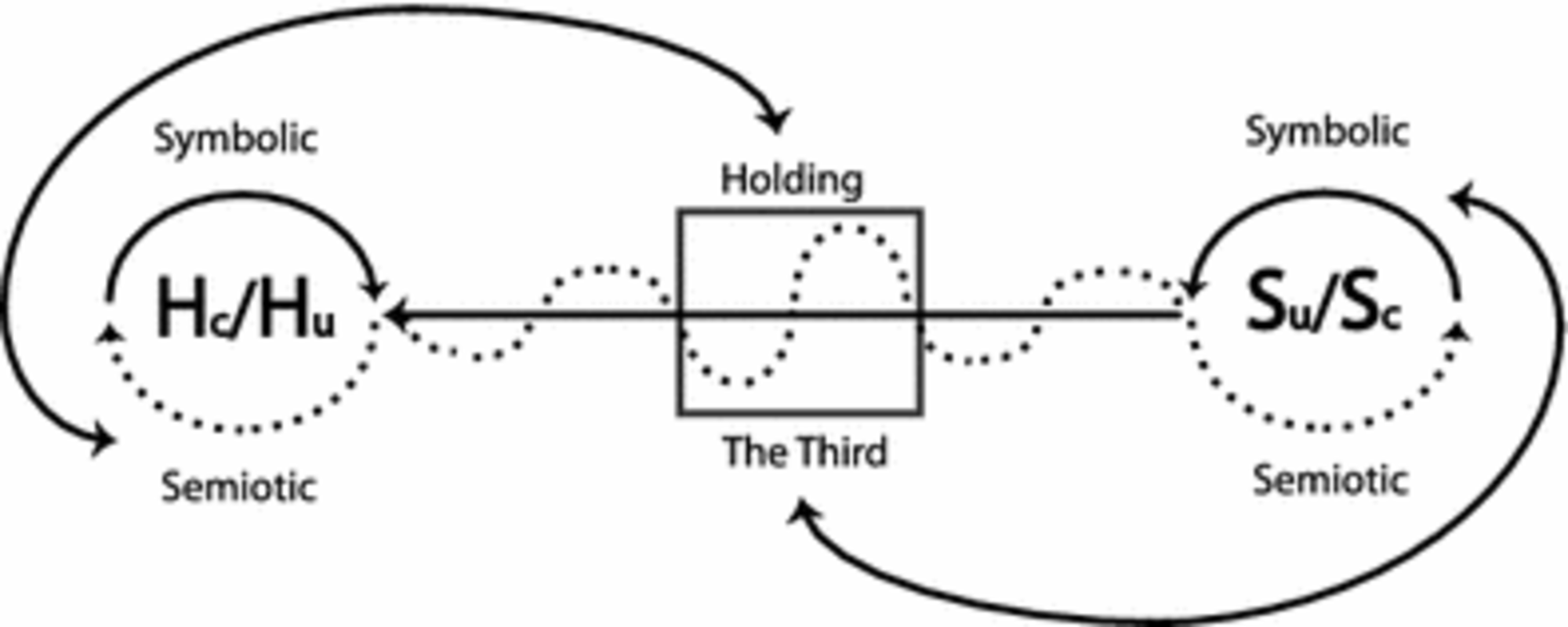
Within the context of the holding environment generated by the healing witness, the basic model would undergo further elaboration (see Fig. 5). The mediating presence of the healing witness is the provisioning of an addressee, or auditor, for the dissociated, undigested memories and sensations of trauma. As noted in the last section, the words, behaviors, memories, and sounds issuing from the survivor are modulated and facilitated by the healing witness who takes on the responsibility of reflecting back to the survivor what has been heard. Recall Charon’s (2006) description of herself as acting almost as a ventriloquist, giving voice to what the “patient cannot always tell in logical or organized language” but rather only “through words, silences, gestures, facial expressions, and bodily postures” (p. 132). The testimony of the survivor, amplified by such listening, is then borne back upon himself where it is re-experienced and repossessed (Laub 1992b). The realization alone that someone is truly listening can sometimes have cathartic effect, as illustrated in this passage:
A 46-year-old Dominican man visits me for the first time … I say to him at the start of our first visit, “I will be your doctor, and so I have to learn a great deal about your body and your health and your life. Please tell me what you think I should know about your situation.” And then I do my best to not say a word, to not write in his medical chart, but to absorb all that he emits about himself—his health concerns, his family, his work, his fears, and his hopes. I listen not only for the content of his narrative but also for its form—its temporal course, its images, its associated subplots, its silences … After a few minutes, the patient stops talking and begins to weep. I ask him why he cries. He says, “No one ever let me do this before” (Charon 2006, p. 177).
In Charon’s depiction of her first encounter with this man, his communication contained for her little, if any, irrelevant noise. Fact finding was not the sole intent of the exchange. Charon is not a modest witness whose job is to arrive at the chief complaint as expeditiously as possible; rather she recognizes that every aspect of the patient’s narrative—“its temporal course, its images, its associated subplots, its silences”—is replete with meaning and opportunities for healing. The measure of a person’s capacity to hold depends on such attentiveness.
Moreover, holding, as the safeguarded amplification of the semiotic, serves, as Kristeva shows, to intensify the survivor’s desire for the reply of the other. The mediating presence of the healing witness is a provocation for the unspeakable to speak. To desire the reply—to speak—requires first the willingness of the auditor to hear: the will to hear precedes and forms the desire to speak. Charon (2006) expresses this eloquently when she writes, “one wants to join, with the patient, as a whole presence, deploying all one’s human gifts of intuition, empathy, and ability to bear witness to each patient one sees” (p. 133). For her, such listening is exhilarating:
Do we not feel exhilarated when we can achieve this empty attention, when we can place ourselves at the disposal of the other, letting the other talk through us, finding the words in which to say that which cannot be said? As an amphora, resonating with the wind, puts sound to the presence of moving air, the listener transduces the words of the speaker into meaning (p. 133).
In Intimate Revolt, Kristeva (1997/2002) explicates the process of listening within the psychoanalytic frame through her concept of forgiveness, or pardon (par, “through” + don, “gift”). Forgiveness here is not absolution. Rather, it is an encounter with the unconscious through “another [the analyst] who does not judge but hears ‘my’ truth in the availability of love and for this reason allows rebirth” (p. 20). Pardon is a conscious act, the will to meaning: “At the onset, within the analytical setup and on the part of the two protagonists, pardon comprises a will, a postulate, a scheme: meaning exists” (p. 20). When the analyst asserts “there is meaning, [she] makes this eminently transferential gesture, which makes a third exist for and through another” (p. 20). In making a third exist, pardon is more than a reply, the offering of a response; it is a form of interrogative listening, a holding through questioning:
I will state the obvious by saying that the analyst gains his knowledge above all from listening, which is nothing other than thinking, interpreting, in words or in silence. But precisely in order to become thought, the erogenous source of speech or the desire to say is metabolized first in a question. Can you deny that to question is to deny? Certainly, questioning begins by rejecting the need or pleasure that pushes the analyst to identify with the patient … What is a question? I question you when I withdraw from allocution and place you in the foreground of this transfer of speech that I decide to call an allocution. I do not accord you the same knowledge as that which I attribute to myself as speaker, but I repartition our psyches: I suppose a part of me in you and await from this part the reply to the question that the other part formulates [italics added] (pp. 145–146).
Kristeva (1997/2002) goes on to note that “without repeating the melodic arc of the question” (p. 146), the psychoanalytic stance assumes the posture of a question that is directed not only at the analysand but also at the analyst’s “own affectivity and symbolic neutrality” (p. 151). By relinquishing the “desire to say,” the analyst creates a place and a time for anamnesis, “‘the search for lost time’ through narrative enunciation” (Kristeva 1996/2000, p. 29). Kristeva (1997/2002) says of the analysand that “you know how to say, how to lie, how to think and formulate the truth” (p. 146). Interpretation is the amplification of the semiotic by the analyst in a naming that questions: “I make affect an inquiry; I raise sensation to the understanding of a sign and introduce the secret traumatization into speech,” so that the symbolic opens for the analysand “not as a fixed truth” but as “an indefinite questioning [italics added]” (pp. 146–147), a continuous giving of meaning and self pardoning.
For a myriad of hypothetical reasons, many trauma survivors blame themselves for the experiences they have suffered (Kauffman 2002a). The inability to speak is often bound to a fear that the telling will divulge some compromising truth about the survivor. Laub (1992b), for instance, claims that “Because of their ‘participation’ in the Holocaust” many survivors, long after their emancipation from the camps, continued to “believe, out of loyalty that their persecution and execution by the Nazis was actually warranted,” that the Nazis “propagated ‘truth’ of Jewish subhumanity” and that “they have no right to speak up or protest” (p. 82). Children from abusive homes often maintain silence for similar reasons.[42] As Laub points out, these delusions are “actually lived as an unconscious alternate truth” (pp. 82–83) that is shared by perpetrators, victims, and bystanders alike. Because traumatized individuals have experienced a world where, as Laub describes it in speaking of the Holocaust, there was no other “to which one could say ‘Thou’ in the hope of being heard, of being recognized as a subject, of being answered,” self witnessing became impossible: “when one cannot turn to a ‘you’ one cannot say ‘thou’ even to oneself” (p. 82).
Pardon is hope renewed in the gift of hearing “that neither judges nor calculates but attempts to untangle and reconstruct,” (Kristeva 1987/1989, pp. 205–206). It is transferential love, where dissociated fragments of time collide with the present in the person of the analyst. As such, forgiveness is the convergence of two levels of subjectivity: “the unconscious level, which stops time through desire and death, and the love level, which stays the former unconscious and the former history and begins a rebuilding of the personality within a new relation for another” (p. 205). Forgiveness is thus a return to the beginning, the recovery of the “imaginary loving father” through an other that “leads the subject to a complete identification … with the very agency of the ideal,” an identification that ultimately allows the analysand “to live a second life, a life of forms and meaning” (pp. 207–208).
It is by virtue of “being the magnet for loving identification” that the other becomes the “very space of metaphorical shifting: a condensation of semantic features as well as nonrepresentable drive heterogeneity that subtends them, goes beyond them, and slips away” (Kristeva 1983/1987, p. 38). This loving identification, for Kristeva (1993/1995), is essentially a transubstantiation, that is, a heterogeneous transference of “body and meaning, metaphor and mystic metamorphosis” (pp. 183–184). Since “there would be no analytical idealization that did not rest on sublimation,” psychoanalysis is, in Kristeva’s (1983/1987) mind, a “form of literary discourse” (p. 38).[43] Unlike linguistic communication, the psychoanalytic exchange is a transferential “unfolding of language,” which, as Kristeva (1985/1987) describes it:
… resonates between two subjects, posed or de-posed. It opens or closes their bodies to its implicit ideals and offers a possibility (not without risks) of psychic as well as physical life. Therapy as deployment of language in all its complexity, variety, and functionality integrates concern … with the ideal…. Its vital efficacy is inseparable from its ethical dimension, which is commensurate with love: the speaking being opens up to and reposes in the other (pp. 60–61).
Repartitioning the psyche, opening up to repose in an other by “supposing a part of me in you,” takes place in two other practices privileged by Kristeva, namely reading and writing. In the work of Joyce and Proust, who both embrace the idea that the word can become flesh, that writing can be a reincarnation, Kristeva finds a model for the analyst (Guberman 1996, p. 16). Joyce’s capacity “to identify with the other, the world, sounds, smells, and the opposite sex” (p. 16), for instance, is a testament to the identificatory power of the analyst, whose imagination, much like that of the writer engaged with his characters, is mobilized by the “analysand’s biography, memories, … and imagined sensation” (Kristeva 1997/2002, p. 61). While admitting such identification, or countertransference, is “an imaginary process,” Kristeva assures us that it too “is nevertheless real, a transubstantiation” (p. 61). Similarly, in the Proustian time of remembrance, in the passage from flesh to word and from word to flesh, Kristeva finds an exemplification of the “practice of psychoanalysis, [which] through transference and countertransference, attempts to reconnect sensation and language” (Oliver 1997, p. 26). Kristeva (1996/2000) argues that the “dynamics of writing in Proust’s work are not all that different from the dynamics of listening that characterize psychoanalytic interpretation” (p. 245). Writing, like psychoanalytic interpretation, is an act of pardon—the effect and the effectiveness of joining flesh to word:
Whoever creates a text or an interpretation … accepts the … act’s appropriateness. It is by making his words suitable to his commiseration and, in that sense, accurate that the subject’s adherence to the forgiving ideal is accomplished and effective forgiveness for others as well as for oneself becomes possible. At the boundaries of emotion and action, writing comes into being only through the moment of the negation of the affect so that the effectiveness of signs might be born. Writing causes affect to slip into effect …. It conveys affects and does not repress them, it suggests for them a sublimatory outcome … Because it is forgiveness, writing is transformation, transposition, translation (Kristeva 1987/1989, p. 217).
Not only does writing convey affects without repressing them, but, by effectively transforming them, it also returns the past as time regained, freed from repetition compulsion. Our ordinary linear conception of time is that of consciousness and discourse (Kristeva 1987/1989), and our narrative memories are inscribed in this time. But, as Freud (1907) discovered, there are traces of the original excitations that remain unconscious and, therefore, Zeitlos, or timeless. Keltner (2011) points out that, if the suffix los is translated literally, then Zeit-los becomes “time” that has “broken off” or “come loose.” Recall from Sect. 2 how traumatic memories appear almost frozen in time as undigested sensations and affects that are unconsciously reenacted in the present, when triggered, rather than remembered—and, if the past is present, Smith (2009) quips, does not that “… make the past timeless?” (p. xv). In writing, as in analysis, these traces resurface readied for remembering. As is often pointed out, the German word for remembering, Erinnerung, is derived from innern meaning “inside,” and Rolland (2009) believes that it was this derivative that enabled Freud to recognize so quickly that the “preservation of a traumatic childhood memory … does not have to do with time that has stopped, but with a fragmented mental space” (p. 48). In other words, Zeitlos lies outside of time and the ego—or, in Kristevian terms, outside of time and language, as a cavern of autistic sensations. Remembering internalizes these traces. Through the process of analysis and literary activity—in the effectiveness of forgiving—“a strange place opens up in a timelessness that is not one of the primitive unconscious, desiring and murderous, but its counterpart—its sublimation with full knowledge of the facts, a loving harmony that is aware of its violences but accommodates them, elsewhere” (Kristeva 1987/1989, p. 200). In remembering, the outside time of “past present” opens to the future—in spiraling (re)turns to the past and “narrative’s flight forward” (p. 258).
Just as writing is transubstantiation, so reading is communion—a mediation of text, which Kristeva says is “an intense empathy with the text, and beyond that, with the interior experience of the writer” (Guberman 1996, p. 207). Kristeva, in an interview, draws attention to the fact that “Proust wished to make readers understand that when they read A la recherche du temps perdu, they are not uniquely in the words, but in the narrator’s body” (Lechte and Margaroni 2004, p. 150). Kristeva stresses that reading, “particularly where Proust is concerned, can inspire us to resuscitate … sensory experience: the smell of the hawthorns, the taste of madeleine, the sound of Saint Mark’s paving stones or the spoons at the Guermantes home—all the little details of daily life that make up the richness of psychic life, as well as life itself” (Guberman 1996, p. 240). Reading leads us, Nussbaum (1990) remarks, “to imagine and describe with greater precision, focusing our attention on each word, feeling each moment more keenly” (p. 47). For this reason, she believes that Proust is probably right “to see the literary text as an ‘optical instrument’ through which the reader becomes the reader of his or her own heart” (p. 47). But it is also an optical instrument that demands we open our hearts to what is seen when reading. It asks that we expand our sympathies to embrace circumstances and concerns that ordinarily we might avoid or deny, “making us reflect and feel about what might otherwise be too distant to feeling” (p. 47). Both Kristeva and Nussbaum insist that the ethical importance of the literary imagination cannot be underestimated:
We all require manifold plastic, polymorphous, and polyphonic identifications, and even if the Eucharist has lost the bewitching power that enabled us to partake in such identification, we will have two choices: we can read literature or we can try to reinvent love. The experience of love and the experience of art, which serve to solidify the identificatory process, are the only ways in which we can maintain our psychic space as a “living system” that is open to the other (Kristeva 1993/1995. p. 175).
Charon (2006) tells us that it was her experience of art, and her personal practice of reading and writing, that led her to develop the field of narrative medicine. In her book on the subject, she talks at length about the play, Wit, written by the then unknown playwright Margaret Edson, a former oncology ward worker. This 1999 Pulitzer Prize drama is about a literary scholar undergoing the ordeal of ovarian cancer and is such a searing portrait of the contemporary experience of illness that, when it first opened in downtown New York, the producers were forced to hire psychologists to facilitate the ad hoc discussions that followed the performances. Charon, who attended the play a number of times, describes an audience left stunned at the end, unable to leave “their seats, some weeping, needing to talk together about what they had witnessed” (p. 18). Initially, she hated the play: “I felt attacked by what I considered to be a crude and one-dimensional caricature of doctors and nurses” (p. 18), but eventually she came to appreciate the play for its service to medicine, for bringing to attention the great divide that separates the physician from his patient: “Health care professionals may be knowledgeable about disease,” Charon writes, “but [they] are often ignorant of the abyss at which patients routinely stand,” having “no idea, most of the time, of the depth and the hold of the fear and the rage that illness brings” (p. 25). Charon has come to learn that if the clinician is to bridge that gap, then “those of us who have elected to live our lives with the sick must ‘wholly attend,’ must be with them, must open ourselves to porous transit on their journeys” (p. 220).
The “poverty of medicine,” Charon (2008) claims, and which narrative medicine attempts to remedy, “is in the dimensions of the figural, the connotative, the meaningful” (p. 25). While Charon recognizes that illness is a biological phenomenon, human beings and cultures vary in their responses to it. As a result, physicians are called upon not only to determine “what the matter might be” but also “what its meaning might be” (Charon and Montello 2002, p. ix). Narrative medicine, rather than skirting medicine’s semantic dimension, advocates combining a scientific expertise with the narrative competence “to follow the patient’s narrative thread, to make sense of his or her figural language, to grasp the significance of stories told, and to imagine the illness from its conflicting perspectives” (p. ix).
As with Kristeva, reading and writing form the cornerstones of Charon’s clinical practice. Reading teaches the physician how to listen and to attend: “Whether in a textual relationship with a book or a clinical relationship with a patient, the reader/listener/receiver uses the self to share in the creation of discourse, neither passively containing nor rigidly dominating the production of the other” (Charon 2006, p. 106). And by virtue of writing full narrative accounts of her patients, what she calls the “Parallel Chart,” Charon says she becomes “more invested in the patient’s particular situation” and is “more likely to remember what occurred on earlier visits and to grasp the significance of actions, words or feeling” (p. 149). Her accounts mingle “all kinds of knowledge—medication dosages, results of diagnostic tests, recent deaths in the patient’s family, the patient’s fears” (p. 149). But more importantly, her accounts reawaken within herself a deeply felt sense of their relationship:
Writing narratively about a patient forces the clinician to dwell in that patient’s presence. In describing a clinical encounter with a patient, I have to sit silently with my memory [italics added] of having been with her. The descriptions of the patient and of myself usually include very powerful interior dimensions—the biological interior of the patient’s body, the emotional interior of the patient, and my own emotional interior. Finally, there is the interior of the two of us. The portrait is the portrait of a dyad. The patient/clinician dyad is doing the work, and both are critical to the work only these two people can do (p. 149).
What the writings of Kristeva and Charon reveal is that reading and writing are not so much forms of communication as they are practices, practices of anamensis that, like Western practices of prayer and recollection, expand the “powerful interior dimensions” (Charon 2006, p. 149) of psychic life and enlarge our capacities for identification and empathy. “Cor am te co r meum et re cor datio mea,” Augustine writes in the Confessions, “My heart and my memory are open before you” (Jager 2000, p. 32). “What has come to be called ‘interiority’ was largely ‘discovered’ by Augustine,” the medieval scholar Jager (2000) claims. Moreover, “throughout his writings Augustine portrayed the heart as the place of ‘writing,’ ‘erasure,’ ‘reading,’ ‘interpretation,’ and other textual operations” (p. 32). The Western association of recollection with writing on the heart is reflected in the Latin word for recollection, namely recordatio and its cognate recordari (“recall,” from re+cordis = “back, again” + “heart” and from which we get the word record). It is from this Western notion of recollection that Kristeva reminds us that “From Socrates-Plato to St. Augustine … from prayer to Georges Bataille”[44] (1998b, p. 31), we have “been invited to a ‘return’” (1997/2002, p. 5):
Some of you still maintain the traces of this, if not the practice. This is notably the goal of Saint Augustine’s repetition, founded on the retrospective link to the already-there of the Creator [the Beginning]: the possibility of questioning one’s own being, searching for oneself (se quaerere: “quaesto mihi factus sum”) [Seeking oneself: “I have become a question to myself”], is offered by this aptitude for return, which is simultaneously recollection, interrogation, and thought (1997/2002, p. 5).
We have been invited to a return, Kristeva (1997/2002) goes on to say, that technological development has rejected by favoring “the knowledge of stable values to the detriment of thought as return, as search (as repetition or as se quaerere, ‘going in quest of oneself’)” (p. 5). In the age of telecommunications and mass media, Kristeva says the practices of reading and writing and of listening and questioning—those intimate practices of re cor datio—are being challenged by the bombardment of stereotypical images, “which calm the anxieties,” but “saturate the purpose of the psyche in such a way that this use of the image stops questioning. We do not look for our own image” (Lechte and Margaroni 2004, p. 153). Indeed, telecommunications and media have come to exemplify the anti-imaginary—in their clichés and ready-mades that strike out what is singular, in their disordering of memory and time that mirrors the traumatic, and in their perturbations (attenuations, erasures, and distortions) of the semiotic that often refuse representation.
What in writing enables the reader to read his own heart, Proust’s “optical instrument” of narrative, becomes in photography, for instance, what Barthes (1981) calls a distressing “floating flash” (p. 53): “the unsettling experience of trauma,” as Baer describes it, “that latently confronts the viewer in every photographic image” (p. 16). The photograph stops speech and time, Baer claims. Unlike narrative, with its illusion of time as flow, the photograph is “another kind of experience that is explosive, instantaneous, distinct” (p. 6). It is the experience of flashback, the sudden eruption of the past into the present. The trauma of photography is visible in the subject as well, Baer declares, since the past that erupts before the viewer is “a remnant of experience that those pictured may never have fully owned at the time” (p. 15).
What are revealed in photographs are undigested bits of memory recorded “photographically, without integration into a semantic memory” (p. 589), as van der Kolk et al. (1994) have said of traumatic memory. Narrative memories are filtered and “are at odds with photographic representation,” Kracauer (1993) observes in his 1927 essay on photography; “From the latter’s perspective, memory-images appear to be fragments but only because photography does not encompass the meaning to which they refer and in relation to which they cease to be fragments. Similarly, from the perspective of memory, photography appears as a jumble that consists partly of garbage” (pp. 425–426). This makes viewing photographs that treat trauma—images of the Holocaust, for instance—a crisis of witnessing. These images call to the future for response, but like the traumatic events themselves, they “will not recede into either forgetting or traditional forms of commemoration” (Baer 2005, p. 94).
Moving pictures also reflect the experience of trauma, as pointed out by a number of psychologists (Butler and Palesh 2004; Greenberg 1975; Wedding et al. 2005). Wedding and Boyd (1999), for instance, describe movie goers as entering “a sort of dissociative state in which ordinary existence is suspended” (p. 1), and Greenberg (1975) calls the big screen “the master hypnotist” (p. 7). For Butler and Palesh (2004), film is unique in its ability to mimic dissociative states, especially derealization. In derealization, the world appears unreal or hyperreal: time speeds up or slows down, objects appear closer or more distant, colors intensify or dull, and sounds become selectively amplified or muted (APA 2000; Noyes and Kletti 1977)—all of these are common visual effects in film. In their review of movies depicting dissociative states, Butler and Palesh conclude that “dissociative elements are integral to the filmgoer’s experience, they are central to the way interior (traumatic) experience is conveyed in film, and they are the plot center of many modern films” (pp. 79–80). Unlike reading narratives about trauma and descriptions of dissociative states, film simulates these experiences for the moviegoer.[45]
Depersonalization is another common dissociative state. In depersonalization, the sense of self, rather than the environment, becomes distorted: individuals may feel dead, as if acting like an machine, or detached, as if floating outside the body. The experience of dissociation, especially depersonalization, runs throughout Benjamin’s (1968) description of film in his famous essay “The Work of Art in the Age of Mechanical Reproduction”—depersonalization is, in essence, the modern experience of the absence of aura or of presence. As Benjamin observes, “The audience’s identification with the actor is really an identification with the camera. Consequently, the audience takes the position of the camera” (p. 228), of a machine—not that of person. Like the camera, the audience becomes detached from reality. It is bound to the cameraman, whom Benjamin compares to a surgeon in the way he cuts reality. “The painter maintains in his work a natural distance from reality,” Benjamin writes, “the cameraman penetrates deeply into its web. There is a tremendous difference in the pictures they obtain. That of the painter is a total one, that of the cameraman consists of multiple fragments which are assembled under a new law” (p. 234).[46]
Benjamin refers to Freud’s penetration beneath perception to the unconscious realm of the drives and draws an analogy between psychoanalysis and film’s penetration into the hidden details of reality:
Then came the film and burst this prison-world asunder by the dynamite of the tenth of a second, so that now, in the midst of its far-flung ruins and debris, we calmly and adventurously go traveling. With the close-up, space expands; with slow motion, movement is extended … slow motion not only presents familiar qualities of movement but reveals to them entirely unknown ones “which far from looking like retarded rapid movements, gives the effect of singularly gliding, floating, supernatural movements.” Evidently a different nature opens itself to the camera than opens to the naked eye … the camera intervenes with the resources of its lowerings and liftings, its interruptions and isolations, its extensions and accelerations, its enlargements and reductions. The camera introduces us to unconscious optics as does psychoanalysis to unconscious impulses (pp. 236–237).
What the camera introduces is an alien semiotics, the mostly unconscious effects produced in the audience by camera positions, its movements and cuts, as well as the accidental introduction of such media artifacts as shifts in aspect ratio and the misalignment of audio and visual channels. These artifacts[47] are disruptive because of their tendency to perturb (write over, jostle, and shove aside) the unconscious, semiotic expressions of human subjects. They produce impressions that do not originate with the subject but yet are often unconsciously confused with him[48] (for a discussion of some of these effects, see, Tiemens 1970; McCain and Wakshlag 1974; Beverly and Young 1978; Reeves and Nass 1996).
The literary critic Hartman (2002) provides a particularly illuminating discussion of the way in which film artifacts introduced disturbing elements in the testimonies of some of the Holocaust survivors who told their stories for the Yale Archive:
The survivors who came to be interviewed were totally supportive; but others—a few historians as well as some survivors not yet interviewed—felt uncomfortable watching the tapes. What disturbed them was partly the emotional, intimate texture of these oral histories, but chiefly their video-visual aspect. Indeed, among the almost two hundred testimonies initially recorded, I now see inspired but also, at times, irritating camera work. Wishing to project the act as well as narrative of witness, we often sought what one of the project’s founders, adopting a legal term, called “demeanor evidence.” The result was excessive camera movement. The supposedly “imperturbable” camera (Kracauer’s word) zoomed in and out, creating Bergmanesque close-ups. Eventually we advised that the camera should give up this expressive potential and remain fixed, except for enough motion to satisfy more naturally the viewer’s eye (p. 74).
Because film viewers are swept along with the camera, they are prevented, in those testimonies where the camera work is excessive, from comporting themselves naturally to listen to the survivors’ narratives. Film is movement: that of the camera, of the beings and things that cross the screen, and of the scenes that flow or that cut into each other. For the camera to focus on someone for as long as the survivor needs to collect himself and to tell his story runs against the medium’s grain, setting up unbearable tensions.[49] An audience is accustomed to being ushered expeditiously in a film to moments of note, which, in the case of a Holocaust testimony, would be when the survivor is able finally to say it. Viewers expect all else—the long pauses, false starts, backtracks, digressions, aborted attempts, and lost threads—to be edited out—for entertainment value, sanitized, except for a choice few that are allowed to remain to create the illusion of realism.[50]
In similar fashion, news programs on television rush viewers directly to the scenes of crimes and other traumas, where they are asked to join in with reporters to investigate what has happened by listening to a quick succession of eyewitness accounts and by examining the most pertinent physical remains and clues. The viewer is allowed to ponder these things for only a brief moment, however, before he is grabbed by the collar, as it were, and dashed off somewhere else. According to Ellis (2000), a former television producer turned academic, television has “introduced a new modality of perception into the world, that of witness” (p. 1). Witness in media is the feeling of being there live, without the actuality of being there, and it is variously described by Ellis as “the sensation of witness,” “the perception of witness,” and “the experience of witness.”[51]
For Ellis, “each medium mimics our fundamental beliefs about what constitutes an adequate perception” (p. 10). In television, seeing is believing, but seeing an event on television is not the same as experiencing it in the flesh. Certain modalities are constricted, such as the full range of self-directed vision and auditory attention, and other senses are entirely removed, such as the sense of touch and smell. Moreover, an artifact in the sensory modalities television emphasizes is the “superabundance of information” (a dissociative hyperreality) that competes for attention and that produces a sense of the uncanny:
There is always more detail than is needed by the narrative; always more present in the image than is picked out by the commentary; always more to be heard than the foregrounded sounds. We see details of clothes and places, hear the distinctive and personal timbre of voices … The effect can sometimes be jarring: a disaster victim weeps whilst wearing a Bart Simpson T-shirt. We choose to ignore the evident disparity and concentrate on their words; or we try to read a complex irony into this chance coincidence (p. 12).
Acutely missing in this “superabundance of information” are interactions with the people being depicted and the ability for viewers to reach out to intervene. This leads to a sense of hopelessness that becomes numbing in disasters of national importance, where the tragedy, time compressed into a tiny loop composed of the most horrific segments, is reenacted endlessly. The “experience of witness” that comes from television and other audiovisual media, Ellis reminds us, is “one of separation and powerlessness” that provokes a sense of “guilt or indifference” (p. 11).
Hartman (2002) has remarked, “That the testimony of the victims of injustice or violence can now be gathered and publicized is a significant advance that could lead to deterrence. Yet traumatic realism often produces an unreality effect; and although this reaction is clearly a psychological defense, it may induce a weakening of the reality principle and lead to the delusion that all the world’s a movie or, obversely, to a radical distrust of the media, as if the latter were always being manipulated” (p. 22). The net result of watching televised traumas and witness accounts, if not television generally, is once again an experience of derealization. Recall that realization requires two activities: presentification and personification. Presentification depends “on our ability to constitute the present as present and to connect the stories we tell about ourselves with present reality and our actual experiences” (Leys 2000, p. 112). Personification is the capacity to take ownership of experiences, to say “This is my experience.” In watching televised accounts of trauma, it is nearly impossible to do either. Television presents the instantaneous, what’s happening this minute, rather than the present. Despite using the many cues of presence—talk hosts and commentators directly facing the viewer and using the present tense along with adverbs indicating present time—the rapid cuts from scene to scene, expert to expert, and witness to witness—all regularly punctuated by extraneous commercial breaks—is divorced from explanation and context: “Information devours its own contents; it devours communication and the social,” as Baudrillard has said (1981/1994, p. 80).
As a “new form of experience” that “arrived with the development of mechanical media” (Ellis 2000, p. 15), the sensation of witnessing now accords with our everyday experience of reality, our fragmentary access to the world watching television. Few today while watching television, for example, would give the following scene described by Postman (1982) much thought:
Vidal Sassoon is a famous hairdresser who, for a while, had his own television show—a mixture of beauty hints, diet information, celebrity adoration, and popular psychology. As he came to the end of one segment of one of his programs, the theme music came up and Sassoon just had time enough to say, “Don’t go away. We’ll be back with a marvelous new diet and, then, a quick look at incest” (p. 81).
Yet how can anyone take a “quick look” at incest or listen to a few sound bites of someone’s experience of rape and not feel complicit in an act that is potentially revictimizing—if not for the televised survivor then for the many rape victims viewing the program? Giving equal time to the testimony of a horrible human violation and a cosmetic commercial dismisses the gravity of the rape experience and reobjectifies the victim. Reflecting along similar lines on these televised confessions, Hartman (2002) asks, “Do we need to hold up the mirror of television to our individual lives? What kind of judgment or justification can come from the (directed) applause of audiences?” He then observes, “There is an increasing frenetic movement into the public sphere that implies a quasi-religious desire to be justified, or at least to be heard [italics added]” (pp. 19–20). In examining the history of the moving picture through television and the birth of the specular witness, Ellis discovers that “cinema’s particular relationship to witness gave birth to that aching desire which haunts much of the aesthetics of the twentieth century: the often frustrated desire for (and fear of) an experience of direct witness [italics added]” (p. 25).
The desire for, yet fear of, the “experience of direct witness” has only intensified in the age of electronic interactivity and telecommunications. In 1844 when Samuel Morse of New York University sent the first electronic message to a person located in another city, Thoreau is reported to have responded, “But what do they have to say to each other?” According to Postman (1982), Thoreau was concerned with the social and psychological impact of communicating long distance with people. He could not fathom what people living in separate communities would possibly have to say to one another that would have any bearing or significance on their lives. Today, however, the situation is radically different, as illustrated by Turkle’s (2011) description of people she observed who had gathered at a recent conference:
Outside, in the hallways, the people milling around me were looking past me to virtual others. They were on their laptops and their phones, connecting to colleagues at the conference going on around them and to others around the globe. There but not there. Of course clusters of people chatted with each other, making dinner plans, “networking” in that old sense of the word, the one that implies having a coffee or sharing a meal. But at this conference it was clear that what people mostly want from public space is to be alone with their personal networks. It is good to come together physically, but it is more important to stay tethered to our devices (p. 15).
Turkle (2011) claims that being distant and alone is starting “to seem like a precondition for being together because it is easier to focus, without interruption, on your screen” (p. 155); and, whether big or small, the screen is now vying with the face as the center of social interaction. Turkle reminds us that not that long ago people took offense when conversations were interrupted by cell phones. She recalls, for instance, one student complaining, “He put me on ‘pause.’ Am I supposed to remember where we were and pick up the conversation after he is done with his call?” At the time, such behavior seemed “rude and confusing,” but today conversations are “routinely interrupted by incoming calls and text messages” (p. 161). In her recent interviews with hundreds of college students, Turkle has discovered a new twist: real-time communication, whether face-to-face or via telephone, is becoming for some the unwelcomed interruption. “I don’t use my cell phone anymore,” Turkle reports a twenty-one-year-old college student saying, “I don’t have the time to just go on and on. I like texting, Twitter, looking at someone’s Facebook wall. I learn what I need to know” (p. 15). Aside from feeling impatient on the phone, some confess not knowing what to say: “My friends call and say, ‘What’s up?’ and I’ll say, ‘Nothing.’ Then I’ll say, ‘Okay, I gotta go. Bye.’ I feel weird talking on the phone. I think it’s easier to text” (p. 245).
What Thoreau and most of his contemporaries could not have imagined in their time was that the transmission of that first electronic message marked the birth not only of global telecommunications but also of its quintessential form: the abbreviated dispatch (which we are still tapping out). The telegram launched a new (utilitarian) era in communications: it dispensed with such social niceties as personal address (thereby democratizing speakers), replaced the private with the public, and forced the elimination of the superfluous—all expressive excesses (Siegert 1999). What has since ensued in the age of texting with cell phone keypads and the 160 character limit of the text message[52] is a proliferation of abbreviations, acronyms, and numeric homonyms (for instance, “h8” for “hate”)—a communication that is neither a form of speaking nor a form of writing but something, as we shall see below, that is experienced more as a swindle, a fraud, and a trap. Word cannot join flesh. Word has no flesh. The abbreviated dispatch shucks the semiotic, leaving emotional expressiveness to a scattering of smiley faces.
Increasingly, the bulk of our daily communications has become impersonal. Messages are not so much addressed to individuals as to ever-shifting multitudes. People log in to conversations rather than have them. As Lanier (2010) describes it, “Communication is now experienced as a superhuman phenomenon that towers above individuals” (p. 4). While admitting to some degree of hyperbole, Turkle claims that “connected life encourages us to treat those we meet online in something of the same way we treat objects—with dispatch”:
It happens naturally: when you are besieged by thousands of emails, texts, and messages … demands become depersonalized. Similarly, when we Tweet or write to hundreds or thousands of Facebook friends as a group, we treat individuals as a unit. Friends become fans. A college junior contemplating the multitudes he can contact on the Net says, “I feel that I am part of a larger thing, the Net, the Web. The world. It becomes a thing to me, a thing I am a part of. And the people too, I stop seeing them as individuals, really. They are part of this larger thing (p. 168).
The individual is being submerged as well in what is electronically known about him. In many ways, the distinction between a person and his “data-identity” (Nevejan 2009) has blurred. A few decades ago, an individual’s data-identity was a diminutive shadow that was rarely noticed—a “personal reductionism,” as Lanier (2010, p. 68) remarks, that has always been a requirement of information systems. Today, however, data-identities, by amassing information from disparate sources, have become substantial and grown in value. Facebook profiles, wall posts, blogs, and Google searches are scrutinized and collected by agencies to personalize ads and make important decisions about people. According to a report by Schiffman (2007), for instance, in North by Northwestern, a university career guide, one in ten employers review a job candidate’s profile, photos, and other information on Facebook as part of their routine decision-making process. Since people are surrounded by systems that “collect, match, duplicate, distribute and even produce ‘data-identities’,” data identities, according to Nevejan (2009) have “acquired great agency in the social structure in which people live” (p. 63). Nevejan (2007) writes:
The use of databases is all around us, even though we do not see them. The stored information has the capacity to affect our lives deeply. It is very difficult, particularly in modern societies, to get to know how our ‘data-identity’ develops: to know where it is stored, with what other information it is combined, who has access to our data, how the data are interpreted. At the same time the use of databases facilitates the easy sharing of knowledge … Through the combining of data about health, travel, financial transactions, stored communication with others and more, the net around the autonomous human being, whose dignity is respected, is growing tighter and tighter (p. 53).
Many people are becoming aware that text messages, photos, and Facebook posts are being recorded and permanently store housed and, in some cases, used to incriminate people. There have been many publicized cases of workers fired—even a tenured professor suspended—because of (relatively innocuous) Facebook posts (Madden 2010; Castagnera and Lanza 2010). Turkle (2011), in her latest book, Alone Together, describes young adults haunted by their online pasts—desperately scrambling to scrub their online histories clean. There is a sense of deep shame and sad resignation in the awareness that “What happens on the Internet, stays on the Internet” (p. 259). “All the things I’ve written on Facebook will always be around,” complains one youth, “So you can never escape what you did” (p. 260). Turkle finds that more people, like Brad below, are becoming fearful of expressing themselves online and are trying hard to self-police themselves:
Brad says that he no longer sees online life as a place to relax and be himself “because things get recorded … It’s just another thing you have to keep in the back of your mind, that you have to do things very carefully.” … Brad steps back from blaming either what the technology makes possible or the people who record you without permission. He says he is a “realist.” By this he means that “anyone who lives in the digital world should know that it is not permissible to lose your temper online or to say anything that you would not want to be distributed.” And besides, says Brad, “there is never any reason to use online communication for spontaneous feeling … You have no excuse for snapping online because you could have just waited for a couple of minutes and not typed anything and cooled down” (pp. 257–258).[53]
This self-policing extends to real life. One woman reports being very careful when out in public since friends could take pictures of her and post them. “It’s like the Internet could blackmail me,” she says (Turkle 2011, p. 256). There is no room for mistakes. Everything is remembered. As one student puts it, “If you’re having a conversation with someone in speech, and it’s not being tape-recorded, you can change your opinion, but on the Internet it’s not like that. On the Internet it’s almost as if everything you say were being tape-recorded. You can’t say, ‘I changed my mind.’ You can, but at the same time it’s already there” (Turkle 2011, p. 259).
According to Turkle (2011), many young people, like Brad above, are feeling cheated: cheated out of their childhoods, which should have been a time for spontaneity and experimentation, cheated from learning how to read emotions as they play across the face, what Brad calls “nuances of feeling” (p. 271), cheated because parents and friends are never really present. What these youths yearn for, Turkle says, is “the pleasure of full attention, coveted and rare” (p. 266). They desire “time and touch, attention and immediacy” (p. 272). Adults are nostalgic for these things too. A woman in her fifties, for instance, tells Turkle that life in her hometown of Portland, Maine, has grown barren. “Sometimes I walk down the street,” she says, “and I’m the only person not plugged in. It’s like I’m looking for another person who is not plugged in … No one is where they are. They’re talking to someone miles away. I miss them” (p. 277).
In the middle of Alone Together, Turkle (2011) takes a moment to retell the history of telecommunications from the perspective of her current findings. It all begins, she says, with the human longing to bring the voices of those we love closer: “We sent letters, then telegrams, and then the telephone gave us a way to hear their voices” (p. 207). Eventually, however, people started using the telephone as a substitute for meeting. By the 1970s answering machines made it possible to leave messages. But people began to use the machines to screen calls, and callers would leave messages when they knew no one would be available to answer. “Over time,” Turkle says, “voicemail became an end in itself, not the result of a frustrated telephone call.” E-mail replaced telephoning because it allowed people more “emotional composure” and control over their time. E-mail replies, however, were not fast enough. With mobile phones and texting capabilities, people were liberated from their desktops. Now it appears “we can communicate our lives pretty much at the rate we live them.” “But the system backfires,” Turkle goes on to say, “We express ourselves in staccato texts, but we send out a lot and often to large groups. So we get even more back—so many that the idea of communicating with anything but texts seems too exhausting” (p. 207). Why, she stops to ask, are people so intent on using technology to filter out the human voice? Turkle feels that she is beginning to understand the answer to this question: “in text, messaging, and e-mail, you hide as much as you show. You can present yourself as you wish to be ‘seen.’ And you can ‘process’ people as quickly as you want to. Listening can only slow you down [italics added]” (p. 207).
It’s a vicious circle. “Overwhelmed by the velocity of our lives,” Turkle (2011) writes, “we turn to technology to help us find time. But technology makes us busier than ever” (p. 17). Charon (2006), for example, looks to the computer to free up time that could be used to write narratives. But as another physician, Groopman (2007), complains, insurers and administrations are filling this time up with demands that doctors see more patients. He reports an administrator telling a colleague that follow-up visits had to be cut from thirty minutes to fifteen and that new appointments had to be reduced from an hour to forty minutes. “When the doctor protested,” Groopman writes, “the administrator told him that there was an electronic solution to make this all possible—a template would be on his computer screen. As he spoke with the patient, he would fill in the form” (p. 99). Although Groopman realizes that “Electronic technology can help organize vast clinical information and make it more accessible,” he is also acutely aware that it “can drive a wedge between doctor and patient” (p. 99) when it is used to increase efficiency rather than help the patient. He complains that “now insurers are packing the train with so many passengers, it feels like standing room only” (p. 100). What is more, Groopman says, doctors now spend what little time they have with patients peering at computer screens rather than observing, listening to, and touching their patients’ bodies.[54]
With the latest systems, physician autonomy is disappearing. Physicians rarely work alone but are increasingly being linked to predefined workflows that information systems are orchestrating. In the new medicine, the patient is often someone the physician has never seen, as much of the work on the patient takes place behind the scenes on laboratory reports and instrumental visualizations of the patient. Medical information systems are big business and grafted onto protocols that are based on best practices rather than individual preferences. In these systems, physicians are viewed as expert cognitive units in a system of many such units, some artificial, and the physician’s ability to act independently is being as severely curtailed as is his ability to spend time listening to patients’ accounts. A physician encountering a traumatized patient like Weinberg’s might today be prohibited by the system from acting outside his prescribed role, and any discomfort experienced facing a patient’s request for psychological support could easily be overcome by the facility of the system to send the patient off into another workflow involving mental health services. Had Weinberg been face-to-face with a computer screen rather than eye-to-eye with his patient, would she have mustered the courage to tell him her secret? And had she done so, could Weinberg have acted as he did?
Although Charon (2006) embraces the benefits offered by electronic medical records, she is concerned “to introduce new, robust means of charting patients’ journeys through illness and to develop responsible methods of articulating their own personal experiences as caregivers” (p. 191). She is adamant that compassionate, ethical medicine, requires an effective merging of both the technological and the reflective:
In developing this form of medical practice, I find myself thinking about the heart. As I sit in the office with a patient, I am doing two contradictory and simultaneous things. I am using my brain in a muscular, ordering way—diagnosing, interpreting, generating hypotheses that suggest meaning … This is the systolic work of doctoring—thrusting, emplotting, guiding action. At almost the same time or alternating with this systolic work is the diastolic work—relaxing, absorbing, making room within myself for an oceanic acceptance of what the patient offers. In the diastolic position, I wait, I pay attention, I fill with the presence of the patient (p. 131–132).
Charon (2006) recognizes that it is not possible to require that all medical professionals respond to patient suffering with compassion and understanding—that is, with a full heart. But she believes that everyone in the medical profession, especially doctors, could be equipped with “compassion’s prerequisites: the ability to perceive the suffering, to bring interpretive rigor to what they perceive, to handle the inevitable oscillations between identification and detachment, to see events of illness from multiple points of view, to envision the ramifications of illness, and to be moved by it to action” (p. 8). By reading and writing narratively, they could at least be trained in the narrative skills necessary to become healing witnesses. But as we have seen, technology is more or less colluding to make “compassion’s prerequisites” all the more elusive—as patients are rarely seen now but rather flow through the system as data manipulated by so many medical functional units.
Across society, technology is being used to avoid direct encounters with others—perhaps, because we no longer have the heart to face suffering, not our own, not another’s. It is just too easy for us to disappear behind the screen, living, as Lanier says, in a “constant sort of fetal position—seated in a soft chair looking at the world through a glass square, be it … the screen of a television or computer” (quoted in Featherstone and Burrows 1995, p. 13). We cannot avoid one another for long, however, without imperiling ourselves. As Charon warns, “The systolic and the diastolic movements of the heart together constitute cardiac function, by which the heart acts, and dysfunction of either is catastrophic” (p. 132).
------------------------------
Note 39: Harben's story extols light: art is light, music streams from the light of heavenly bodies, light is everywhere and darkness comes only at the end. Evil has disappeared because there is nowhere for it to hide. But the mouth gives the story away. It is abandoned as the site of speech not so much because it is unbecoming for perfect communication to issue from a bodily part as base as the mouth, erogenous orifice of eating and drinking, but because this story reflects an unconscious desire to return to the serenity of the womb, the time in one's life when needs were met instantaneously without having to express them or perform the labor of using one's mouth to secure them—to ask for and to receive by sucking—that is, the time before jaw muscles were called into action. Harden's story is not a vision of the future so much as it is the mourning of a lost past, a lost illusion of wholeness—the time before desire. Nonetheless, it is interesting that love immortal at the end of the story is juxtaposed to a fleeting hint of death and a desire for meaning. The fact death's proximity impinges on the father and the purpose of life concerns the son, if only for a moment, indicates that not all shadows have been eradicated. Even in this world, there are thoughts obscured by the light that, though they may not be heard, they are whispering.
Note 40: Kristeva, following Lacan (1977, pp. 55–56), sees a trajectory that leads to transcendence—but it is one that breaks out into the world. Moreover, it is a transcendence rooted in listening, specifically, listening to those in need of connecting the symbolic to the semiotic: "Freud has provided us with a preliminary method for achieving this sort of listening, but we still need to elaborate our approach. Our empathy and familiarity with the malady of the soul will enable us to transcend the psyche—forever" (Kristeva 1993/1995, p. 29).
Note 41: A hint of interpretive capacity in the sense that the destination, in Weaver's modification, seems capable of extracting additional meaning from the semantic noise that the source inadvertently injects. The inclusion of a semantic receiver is a recognition that semantic capacity varies significantly among people. Perhaps this is why Weaver considers semantic noise potentially enhancing. However, this potential seems to go against the purpose of the semantic receiver. In mapping semantic content to the semantic capacity of some known audience, a capacity predetermined statistically, it is quite possible that any additional meanings introduced by semantic noise would be rendered null. Moreover, it is not clear whether Weaver is considering this mapping in terms of the range (what is possible for the audience), the lowest common denominator, the average, or the norm of a given audience.
Note 42: Moreover, the intense feelings of animosity and hatred that naturally arise towards perpetrators, and the desire for revenge, may lead some survivors to feel that they are no different from the perpetrators: many survivors end up directing this anger against themselves (Summit 1983; van der Kolk 1996).
Note 43: In Intimate Revolt, Kristeva (1997/2002) explains more fully how the act of naming takes place within analysis:
The act of naming implies abandoning the pleasure and pain of carnal identification, of carnal texture, in order to dissociate thing-presentation and word-presentations. Interpretation fixes word-presentations in their arbitrary autonomy as signs distinct from perception-sensations. It even turns them into fetishes, leads the patient to play with these words-signs-fetishes, and gives them back to him, like a mother to her child, as playthings, first of all. From his flesh, which we have shared with our own, we make word-presentations. But in placing, repeating, and punctuating these words, we give them the consistency of reified symbols; we bring them closer to thing-presentations, like writers who repeat, love, and arrange their texts … Thus, starting with sensorial fixations, analysis works out sensorial games and then words—but word pleasures, word-fetishes. To describe this naming in which the therapist engages, we could say that it is the art of producing transitional objects, starting with the flesh of sign (pp. 61–62).
Note 44: "From Socrates-Plato to St. Augustine, Western thought affirms that the truth of (the form of) Being preceding human existence can be attained by a movement of retrospection: ‘se quaerere,' ‘quaesto mihi factus sum.’ This common destiny of truth, memory, and speech has, after Augustine, found its affirmation in the interior experience that—from prayer to Georges Bataille—never ceases to reveal the scandalous effects of what I mean precisely by a ‘re-volt'" (Kristeva 1998b, p. 31). Kristeva (2005/2010) also repeats this mantra in Hatred and Forgiveness, where, it is interesting to note, it is associated with the tripartite practices of listening, writing, and reading (see pp. 277–278).
Note 45: That film is a simulation is borne out, in my opinion, by the fact that it is used to induce and test for motion sickness, see for instance Cowings et al. (1986) and Parker (1971). I am unaware of any report where narrative induced in the reader any form of motion sickness.
Note 46: Benjamin also presents another interesting expression of depersonalization in film from the perspective of the actor by quoting Pirandello's descriptions of what it feels like for the actor to perform before the "mechanical contrivance" of a camera:
The film actor feels as if in exile—exiled not only from the stage but also from himself. With a vague sense of discomfort he feels inexplicable emptiness: his body loses its corporeality, it evaporates, it is deprived of reality, life, voice, and the noises caused by his moving about, in order to be changed into a mute image [in silent pictures], flickering an instant on screen, then vanishing into silence … The projector will play with his shadow before the public, and he himself must be content to play before the camera (quoted on p. 229).
Note 47: As defined in Webster's Third New International Dictionary as "a product of artificial character due to extraneous agency" (Gove 1986, p. 124). I introduced this idea in (Brahnam 2009).
Note 48: This is what makes videotaped court testimonies problematic. Vertical camera angle, for instance, has been shown to influence impressions of the subject’s credibility (Tiemens 1970). As Balabanian (1981) succinctly puts it, "High shots produce pygmies. Low shots yield monoliths of the Citizen Kane type" (p. 27). In situations where credibility is crucial, such as in videotaped interrogations, direct manipulation of camera angle can have devastating consequences (see, for instance, Lassiter 2002; Locke 2009; Hemsley and Doob 1976). Even changes in the vertical position of the viewing screen have been observed to influence receiver perceptions of the subjects credibility (Huang et al. 2002).
Note 49: The camera must move, as Hartman (2002) says, if it is "to satisfy more naturally the viewer's eye" (p. 74). As we interact with people, our heads and bodies move subtly and continuously, varying our field of vision. We expect something similar from the camera as well. A camera that remains stationary produces a feeling of staring. This effect was powerfully put into play in the French film Irreversible (Noé 2002), where the camera held steady for a full nine minutes while a rape took place, thereby placing the audience in the uncomfortable position of cold-hearted accomplice.
Note 50: There are exceptional films that push the limits. Take, for instance, the director Lanzmann, who attempted "to reincarnate" the Jewish tragedy in Shoah, his monumental documentary of the Holocaust (Bernstein 1985). The film, which took him over ten years to make, is created entirely from the testimonies of present day witnesses. No historical documents or film footage was used. In Lanzmann's opinion, "using only images of the present, evokes the past with far more force than any historical document" (Bernstein 1985). Lanzmann's patience permeates the nine hour film with its slow camera work and willingness to let the witnesses tell their stories in the pace most comfortable for them. The film strains the powers of audience endurance, especially contemporary audiences, and, in so doing, has the potential of stretching the viewer's capacity to listen and to open up to the suffering of others. Here is an excerpt from VideoMan's (2009) comment about Shoah, published on Amazon.com, that reveals the tension that was generated in him by the film:
The subject matter is very critical for all of us to hear and understand. The editing was very poor in the sense that I lost interest in awaiting responses. I will watch all of the rest of it, but hope I get used to the slowness of the dialog … I am disappointed as I wanted to learn and for others to learn and "take in" subject matter that I felt was so very important and necessary for the world to know. Maybe it's just my impatience and others can learn and not be distracted as I have been. I am not ADD just the kind of person that needs emotions and words to coincide in a timely manner. The film is very good from what I've seen so far and I guess I have to realize the author is not a Spielberg.
Note 51: These are the expressions Ellis uses when discussing witnessing in the context of audio–video media.
Note 52: The 160 character limit is arbitrary. One day in 1985, Friedhelm Hillebrand sat down at his typewriter and typed a few pages of random sentences. He discovered that none counted more than 160 characters. "This was perfectly sufficient," Hillebrand recalled thinking later, "perfectly sufficient" (Milian 2009). As he was chairman of the non-voice services committee within the Global System for Mobile communications, or GSM, the group that defines the standards for the global mobile marketplace, he was able to push his 160 character limit. Hillebrand remembers wondering with a friend whether that was enough space to communicate most thoughts. He is reported to have said, "My friend said this was impossible for the mass market. I was more optimistic." Twitter capped the length of tweets to 140 characters to reserve 20 characters for the user's address. Facebook and other messaging systems have found it to be "perfectly sufficient" as well, since most people restrict their communications, as Lanier (2010) points out, to telling others what they are doing.
Note 53: Turkle comments that "Here we see self-policing to the point of trying to achieve a precorrected self" (p. 258).
Note 54: For a review of the literature on the impact of the computer screen in the consultation room, see Shachak and Reis (2009).