This research explores the social, ecological, and institutional rhythms of Tuindorp Oostzaan as part of the Ground for Wellbeing project. It looks at how patterns of daily life, natural cycles, and governance processes interact over time—and how this interaction shapes the neighbourhood’s capacity for social inclusion and climate adaptation.
The social rhythm analysis uses a participatory, ethnographic approach to document residents’ everyday routines: their daily, weekly, and yearly activities, and the places they regularly visit within and around Tuindorp Oostzaan.
The ecological rhythm analysis focuses on recurring natural cycles—such as seasonal change, plant growth, and species movement—and how these rhythms intertwine with human activity. By linking local observations to existing ecological data, the study helps uncover how environmental and social patterns connect across space and time.
The institutional rhythm analysis examines how municipal and organisational processes—such as policy cycles, development plans, maintenance schedules, and funding schemes—unfold at monthly, seasonal, and yearly scales. Working with partners such as Ymere, Waternet, Liander, and local organisations, the research identifies how these institutional tempos align or clash with everyday and ecological rhythms.
Together, these perspectives provide a rhythmic understanding of Tuindorp Oostzaan as a living system, where people, nature, and institutions continually shape one another over time.
Rhythmanalysis in Tuindorp Oostzaan
Neighbourhood rhythms can be understood as the regular patterns of activity that shape everyday life—how residents move through spaces, meet others, care for their surroundings, and rest. These rhythms unfold in time and space: some occur daily, such as commuting to work or school; others weekly, like sports or community gatherings; and some shift seasonally, as people spend more time outdoors in summer and retreat indoors in winter.
This research aims to identify and map the specific rhythms of Tuindorp Oostzaan—where and when they occur, and how they give form and meaning to local life. Yet neighbourhood life is not defined by social rhythms alone. It is also intertwined with ecological rhythms, such as the cycles of plant growth, animal movement, and seasonal change, and with institutional rhythms, such as municipal planning processes, maintenance schedules, and policy timelines.
By studying how these different rhythms overlap or diverge, rhythmanalysis reveals the hidden temporal structure of the neighbourhood—the way human, natural, and institutional processes continuously interact. Making these patterns visible helps planners, policymakers, and communities to develop strategies that move in rhythm with local life. It ensures that new initiatives for climate adaptation, social inclusion, or public space design are rooted in the lived experiences and ecological realities of the place itself.
Research area and participating neighbourhoods
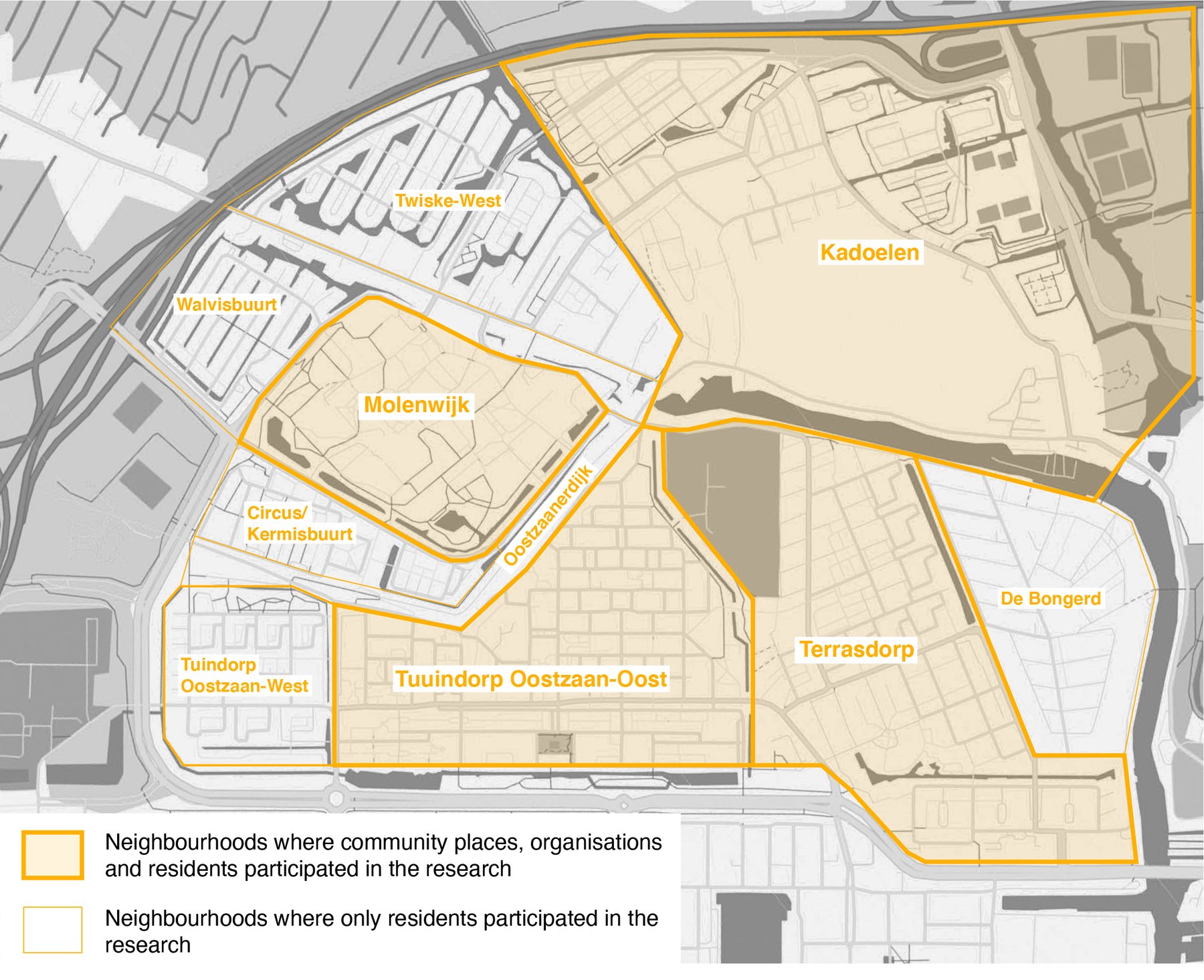
Although Ground for Wellbeing specifically focuses on Tuindorp Oostzaan-West, in practice, this neighbourhood is closely linked with its surroundings. Many residents from neighbouring areas partake in activities or utilise facilities in Tuindorp Oostzaan-West, and conversely, residents of Tuindorp Oostzaan-West frequently visit other neighbourhoods for their daily or weekly activities.
For this reason, the rhythm analysis research was conducted in Tuindorp Oostzaan and its surrounding neighbourhoods. It wasn't limited to a single district but examined a network of interconnected communities where residents and organisations are linked. As rhythms are not confined to a specific area but are spread across a wider urban fabric, drawing an interconnected perspective to rhythm analysis was a crucial aspect of the research.
In Tuindorp Oostzaan-East, Molenwijk, Kadoelen, and Terrasdorp, the project collaborated with community spaces and social organisations. Meanwhile, in neighbourhoods such as Tuindorp Oostzaan-West, Circus/Kermisbuurt, De Bongerd, Walvisbuurt, and Twiske-West, residents mainly engaged on an individual level.
Engaging Community Places and Social (bottom-up) Initiatives
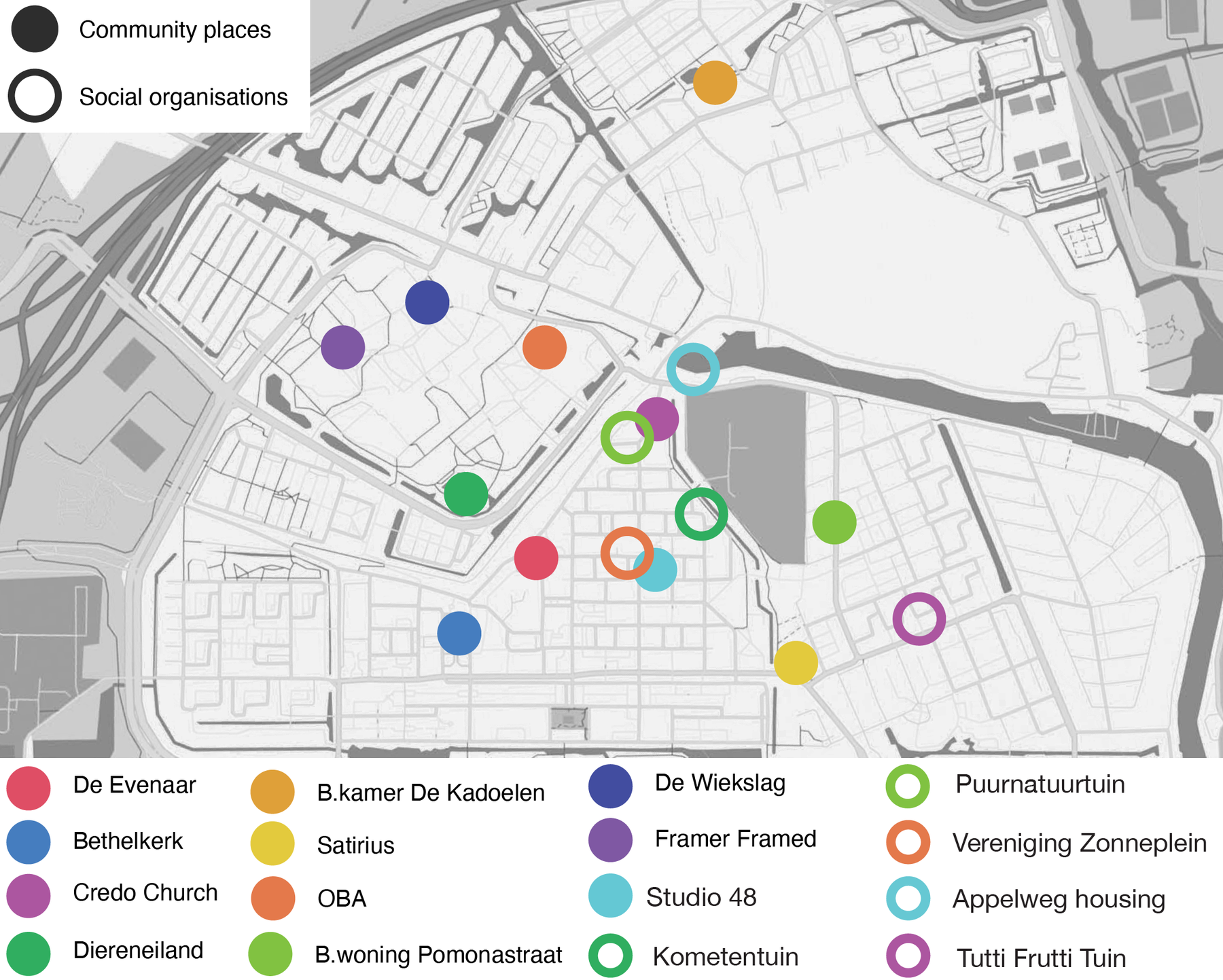
Rhythms emerge not only within households or workplaces but also in places where people voluntarily come together. These are the places where social rhythms are most visible: community centres, churches, and grassroots initiatives that bring people together around shared interests or recurring activities such as shared meals, sports classes, or creative workshops. At the same time, they are where self-orchestration happens when it comes to engaging with ecological rhythms, such as through gardening initiatives. Institutional rhythms are also practised locally through social organisations. In this research, a key focus was on collaborating with community places and resident-centred organisations that serve as important anchors of neighbourhood life.
Before starting collaborations, I first mapped and analysed the rhythms of these organisations. This helped identify not only how a collaboration could be established, but also where and when it could best take place, ensuring that the research was attuned to the community's lived experience. A deliberate effort was made to include a range of organisations and initiatives, ensuring that different lifestyles, age groups, and daily routines were represented. Many of these initiatives originate from within the community itself, and their rhythms reflect the diverse ways in which people inhabit and shape their shared environment. Through these collaborations, the research was able to reach a rich and varied range of participants – young and old, long-time residents and those new to the neighbourhood.
The Ethnographic Trajectory
The ethnographic trajectory started in February 2025 with volunteer work at community centre De Evenaar on the Plejadenplein, gradually expanding to other locations and activities over the following months. Figure 3 illustrates the development and intensification of this engagement from February to July 2025. Starting with the initial contact at De Evenaar, the network of participating residents and organisations expanded weekly, as shown in the graph.
Initially, weekly engagement at De Evenaar involved preparing meals for the elderly, but it soon grew to include volunteer work at various neighbourhood activities and events. During the first phase, I primarily participated in recurring activities, such as breakfast and lunch, at De Evenaar. Over time, this expanded to events at Bethelkerk, monthly dinners and coffee mornings at Satirius, lunch gatherings at Credo Church and De Kadoelen, and breakfast at Diereneiland. I also engaged in creative and sports programs, such as art classes at Framer Framed Molenwijk and De Evenaar, as well as walking groups organised by De Evenaar and the OBA (Public Library). Additionally, I contributed to neighbourhood gardening projects, such as the Kometentuin, Puurnatuurtuin, and Rozijnentuin, which are integral to residents' daily routines. Lastly, I took part in various seasonal neighbourhood events, including markets, performances, and festivals.
This gradual approach fostered deep-rooted engagement within the neighbourhood and helped build a strong local network, as well as trust-based relationships with residents and representatives of community organisations. A long-term presence in neighbourhood activities allowed for a nuanced understanding of the rhythms that shape daily life in the neighbourhood— who participates in which rhythms, where and when they reinforce each other, or when they fail to align. Additionally, a representative group of participants was engaged, providing a detailed picture of the different rhythms that influence daily life in the neighbourhood.