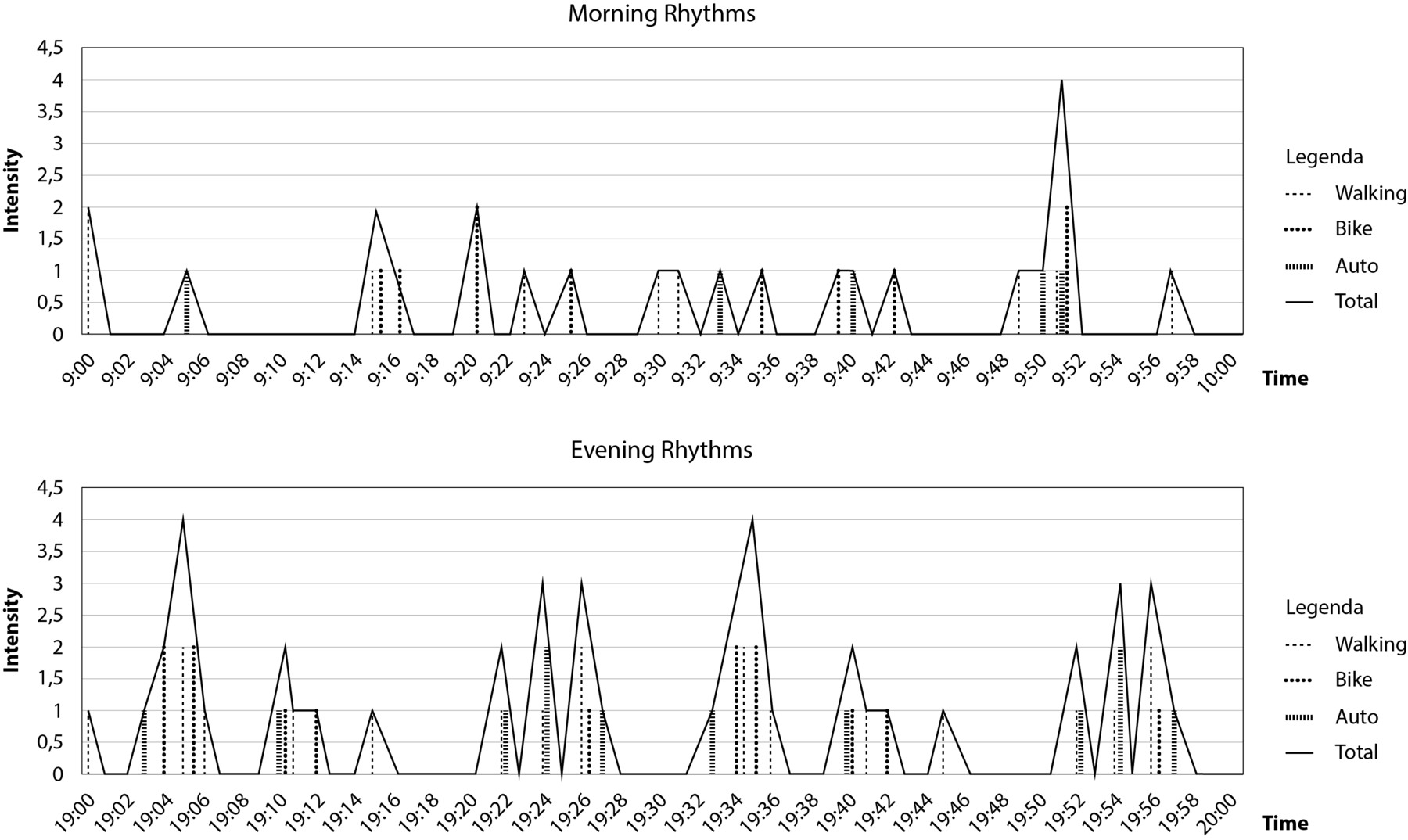
In the various case studies produced through the City Rhythms project, the research helped identify a variety of rhythms in the particular urban environment. The mapping of rhythms was a means to trigger discussions with residents and entrepreneurs in the neighbourhood. In the Zaanstad case study conversations were informed by people’s physical experience on the square and therefore debates were intense. The visualization could also be a trigger to express prejudice (the older residents assumed these were jobless youngsters who would do no good to the neighbourhood). Nonetheless, while the visualizations of rhythms in the physical environment did prompt expressions of prejudice, the interviews with the youngsters proved these views were generally false. Equally, however, the visualization showed that the older people were right in that indeed between 17:00 and 18:00 the intensity of the square was very high. Because of the visualization, people in the neighbourhood engaged in analysing what was going on and found that different perspectives on the differing perceptions were possible. A key conclusion is that rhythm analyses can function as a boundary object. In other words, that different ways of thinking and viewing a situation (whether due to specific socio-cultural views, based, for example, on generational thinking, or from different disciplinary discourses, such as between individual and council officials) can be brought to accord, or at least brought together around a shared ‘object’ of debate. Rhythm offers a means to bring different points of view, beliefs and concerns together. Different understanding and ways of formulating a problem can be seen to step over the ‘boundaries’ different perceptions and modes of thinking.
In the Amsterdam and Rotterdam cases the focus was on identifying rhythms in social life. By executing in-depth interviews, the daily life of different actor groups could be understood and visualized from a rhythm perspective and compared with an understanding and visualization of rhythms in activities from other actor groups. Here the comparison between the different rhythms was the trigger for conversations. In Amsterdam, the municipality had not realized that the mothers could not fit the rhythms that the municipal services offered. In Rotterdam, the people had not realized that young and old actually hardly meet because of their personal rhythms and that most opinions about each other were therefore mostly based on ignorance. Again, a conclusion can be drawn that rhythm analyses functions as a boundary object, facilitating a conversation about social structures and interactions, offering unexpected insight in these structures and interactions, and as such, in the Rotterdam case, inspiring new service design solutions.
The representation of rhythms through visualization is crucial to the functioning as boundary object (Star & Griesemer 1989). Professionals skills, coming from architecture in the case of the City Rhythm research, were indispensable for creating convincing boundary objects. It was also of vital importance for a boundary object to be the centre and trigger of a conversation. The City Rhythm research organized several focus groups in every case study in which rhythms were discussed and in which new design solution spaces and possible rhythm interventions were discussed. Key aspects can be said to characterize a boundary object: identification of context, identification of actors, presentation of issues, conversation and analyses, inventory of possible interventions. And each of these is part of the new methodology for rhythm analyses that is outlined in the final section below (Star & Griesemer 1989).
A key, underlying concern of this research has been in identifying the gap in the ‘methodology’ for rhythm analyses. Lefebvre (2004) introduced the notion of rhythm analyses as a means to a better understanding of cities in his seminal work Rhythmanalyses: space, time and everyday life. A well-known passage, which offers an intriguing analysis, is of a rhythm analyses of Rue Rambuteau, as seen by Lefebvre from his window, and which reads like a rich anthropological description of one street in Paris. However, descriptions of territory do not offer a methodology for analysing what creates the territory, i.e. for what holds its different flows together, how rhythms create transitions within the territory, or how to grasp the interaction between space and time. In fact, Lefebvre’s analysis of Rue Rambuteau could be said to be easily ‘falsified’ by Claire Revol (2012) who examines the rhythm of the same street in her essay Rue Rambuteau Today: Rhythmanalysis in Practice. She ends up with very different conclusions. Revol’s study underlines that ‘the observation that Lefebvre undertakes in rhythm analysis is not comparable to social science observations’ and ‘the importance of practice in the rhythm analytical project’ (Revol 2012: 4).
During the trajectory of City Rhythm, it was found that Marli Huijer’s definition of rhythm, ‘as variation in a pattern in a given structure’, opens up different avenues into new thinking, since it creates the chance to reflect on three notions to understand rhythm: pattern, given structure/context and variation. However, Huijer, does not make this definition operational for rhythm analyses. One can ask, then: How does one recognize variation? How much variation can happen for a rhythm to remain congruent? What can be understood as ‘the specific structure’ of the neighbourhood? In a neighbourhood or city different people will experience specific rhythms in different ways. The distinction that Dewey makes between rhythms that allow aesthetic experience and consumption of movements, or the distinction that Lefebvre makes between formal space and social space, contribute to the explanation of why certain spaces influence people to engage with each other or with their surroundings while others do not. It should be possible to identify the subjective experience of rhythm in these terms. However, Dewey, while offering a new perspective which looks at rhythm in everyday life, does not offer a framework to analyse rhythm as an aesthetic experience. In the same manner, Lefebvre’s separation between the formal and social spaces misses a framework of analysis. Such a framework is significant to understand what interventions should be proposed to generate an aesthetic experience. The lack of any such methodology creates a gap of knowledge between the theory of and analysis of urban rhythms. Between the various conceptions of rhythm, it may be useful to develop a scientific methodology for unfolding and analysing the rhythms in an urban environment. The following section outlines steps from the work of the City Rhythm as a means towards a more encompassing and repeatable methodology.
Towards a Methodology of Urban Rhythm Analysis
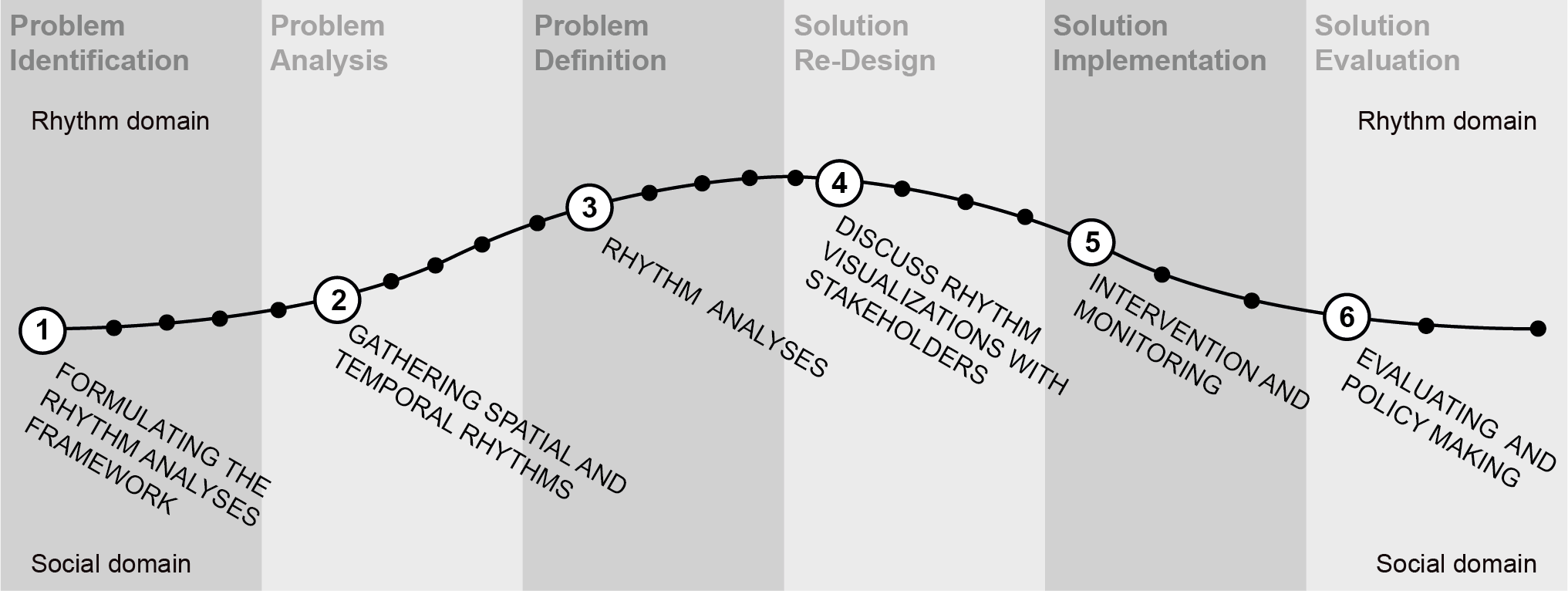
What follows is a proposed methodology for Urban Rhythm Analyses in social urban environments. It sets out six main steps: (1) formulating the rhythm analyses framework; (2) gathering spatial and temporal rhythms; (3) rhythm analyses ; (4) discussion of rhythm visualizations with stakeholders; (5) intervention and monitoring; and (6) evaluation and policy making. How the steps evolve is represented through a curve (Figure 4) that starts from the social domain in step one, arrives to the rhythm domain in steps four and five, and finally comes back to the social domain in step six.
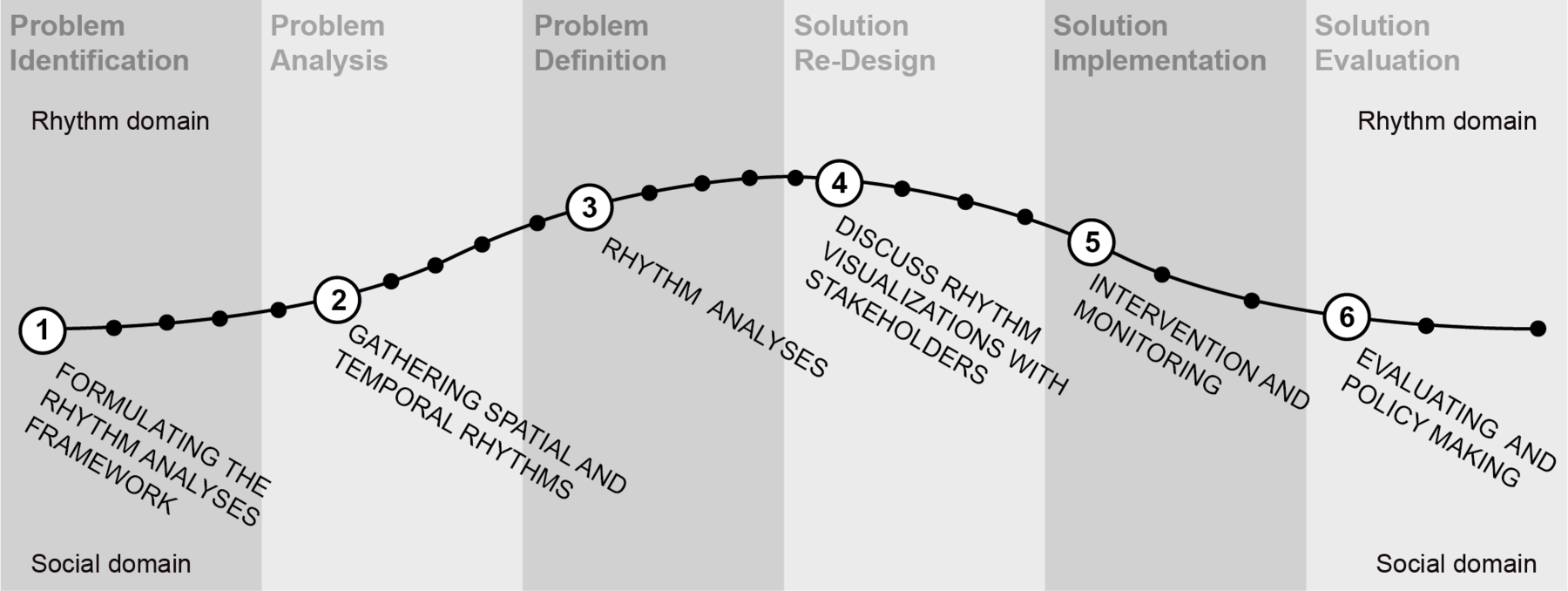
As a result of the explorations in the six case studies of the City Rhythm project, the aspects are identified for rhythm analysis to function as a boundary object. In order to respond to the knowledge gap, this methodology brings together these identified features, presenting them in six main steps. The methodology can also be seen as an organized collection of architectural techniques (e.g. documenting spatial findings through photographic research, sketches and analytical maps), as well as social science research techniques, including surveys and interviews, focus group sessions with stakeholders, and the use of boundary objects for facilitating communication. These research methods are used in different stages and together construct the methodology for rhythm analyses of social urban issues.
Steps 1-3: Defining the Problem
The methodology starts with ‘Formulating the Urban Rhythm-Analyses Framework’. This opening step is the exploration phase where stakeholders and researchers engage in focus group sessions for identifying a research question. Following this, initial ideas about the social issues in urban contexts are developed by the researchers based on interviews, and initial studies on rhythms which are significant to the social issue are carried out with spatial, social, ecological and functional analyses. After going through these processes, the researchers bring together the results for formulating the general framework for the analyses.
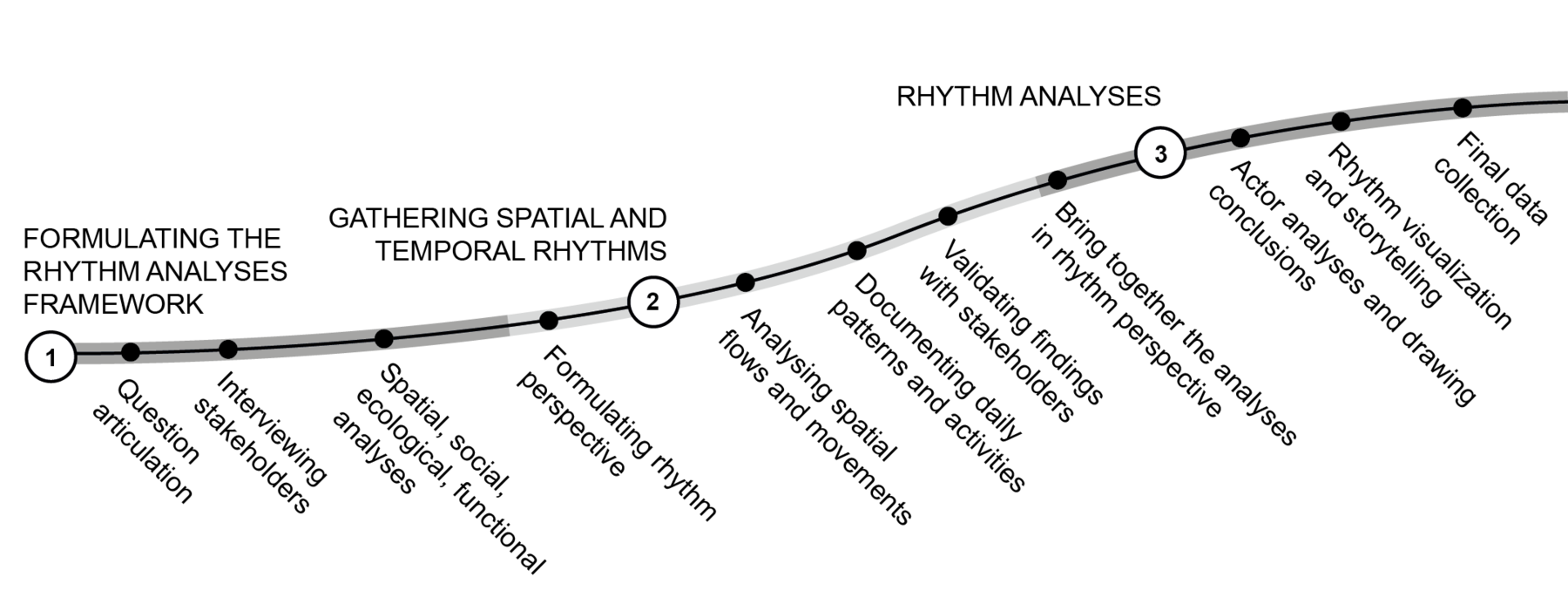
The second step focuses on the physical structure of an urban area where the social issue takes place. The spatial flows and movements as well as daily patterns and activities that are present in the neighbourhood are analysed and documented. These two sub-steps include architectural analytical methods such as sketches, photography and mapping and study the people’s movements and standing points in a neighbourhood in relation to the functions. From the social sciences expertise and methodology about demographics, social structures, human interaction and political dynamics are used. At the same time, the time frame in which the intensity of the different movements changes, or the hours in which the functions in the neighbourhood take place are studied.
An important step in the methodology is ‘Spatial, social, ecological and functional analyses’. In spatial analysis, unique characteristics of the environment create different rhythms. How wide a street is can affect the walking speed of the people (Gehl 2011). In the same way, the cars that are parked in a neighbourhood square can have an impact on the amount of time the visitors choose to spend there. These factors are recognized and documented in the spatial analysis. Here also the socio-economic and political division of use of space is being studied and mapped.
In an ecological analysis, the observer is confronted with the ecosystems that the neighbourhoods are part of, and the dynamic relationship between people and the notions that shape these ecosystems. The role that nature plays in the rhythms of the neighbourhood, and the relation and rhythms of citizens in this local ecology is analysed. Demographics significantly influence the rhythm in an urban area. There are big differences between the rhythms of young neighbourhoods and those where the elderly forms the majority. The same holds for neighbourhoods comprised of large families or of small households. This analysis has different sources and can be executed with digital data as well.
Functional analysis is used to understand the activities that shape the structure of rhythms in an urban area. Functional analysis can be carried out by visiting the neighbourhood of analysis and documenting the functions, or through digital methods such as online search engines or datasets from municipalities that indicate the different shops, businesses, parks, schools or other public and private amenities. When these methods are brought together, a thorough understanding of the urban and social context is established.
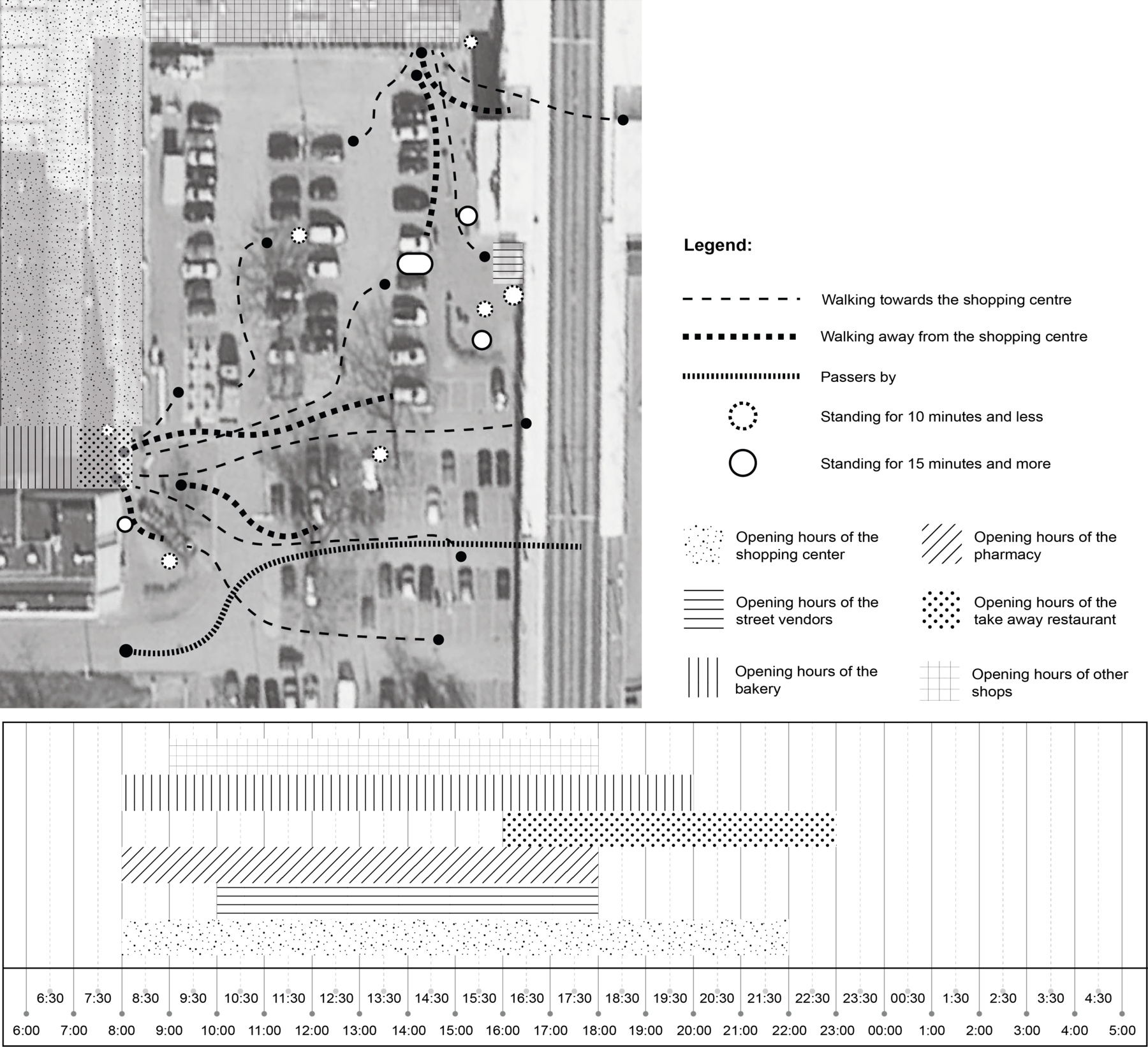
In the third step of the methodology for Urban Rhythm Analyses, after selecting the rhythms that are relevant to the social issue, further data is collected on the actor groups involved with the issue. Then findings are visualized in order to create scenarios for rhythm-story telling. While the actor analysis is carried out by choosing target groups, creating persona’s and visualizing their periodical rhythms (daily, weekly, or monthly), in the rhythm-story telling step the results of the spatial and functional and actor analyses are integrated together for creating one storyline. Personas can be used for understanding the actors that play a main role in the analysed social issues. By bringing together the information gathered from interviews, surveys and site research, these analyses allow to document the activities that the different groups carry out during the day with specific hours, arriving to visualize the daily or weekly rhythms of an actor group.
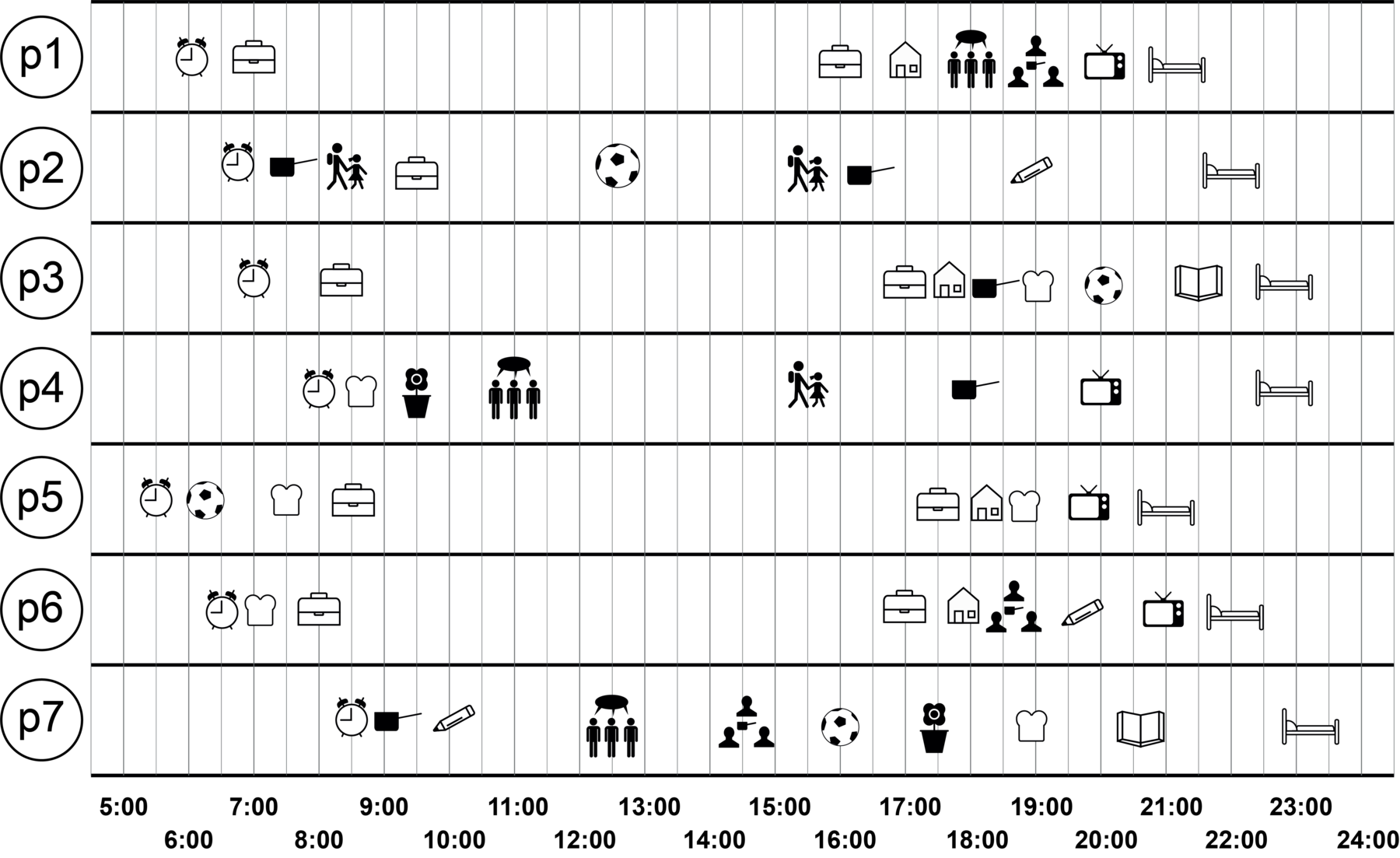
Afterwards, a final data collection is made in order to enrich these analyses. The third step of the methodology is concluded with making rhythm analyses into a boundary object, which takes place by critically combining and comparing the results based on the initial research question. Representing these comparisons visually enables stakeholders to collectively reflect on the rhythms that affect a specific social issue and make conclusions regarding the rhythm domain.
Steps 4-6: Solutions and Evaluation
So far, the researcher has articulated the research question, conceptualized the rhythm perspective of the social issue, identified, visualized and measured rhythms in neighbourhoods and in the activities of people. Based on this trajectory, the researcher has moved in the analysis from the physical domain to the rhythm domain. In the fourth step, triggered by the visualizations, a design solution space is defined in collaboration with stakeholders. This step is carried out through a series of workshops with stakeholders in which the rhythm-boundary object is presented through a visual and comparative narrative of the rhythms based on the spatial, ecological and functional and demographic analyses and that of the persona’s. Following this, the stakeholders reflect on how the different dynamics relate to each other in order to identify a design-solution space.
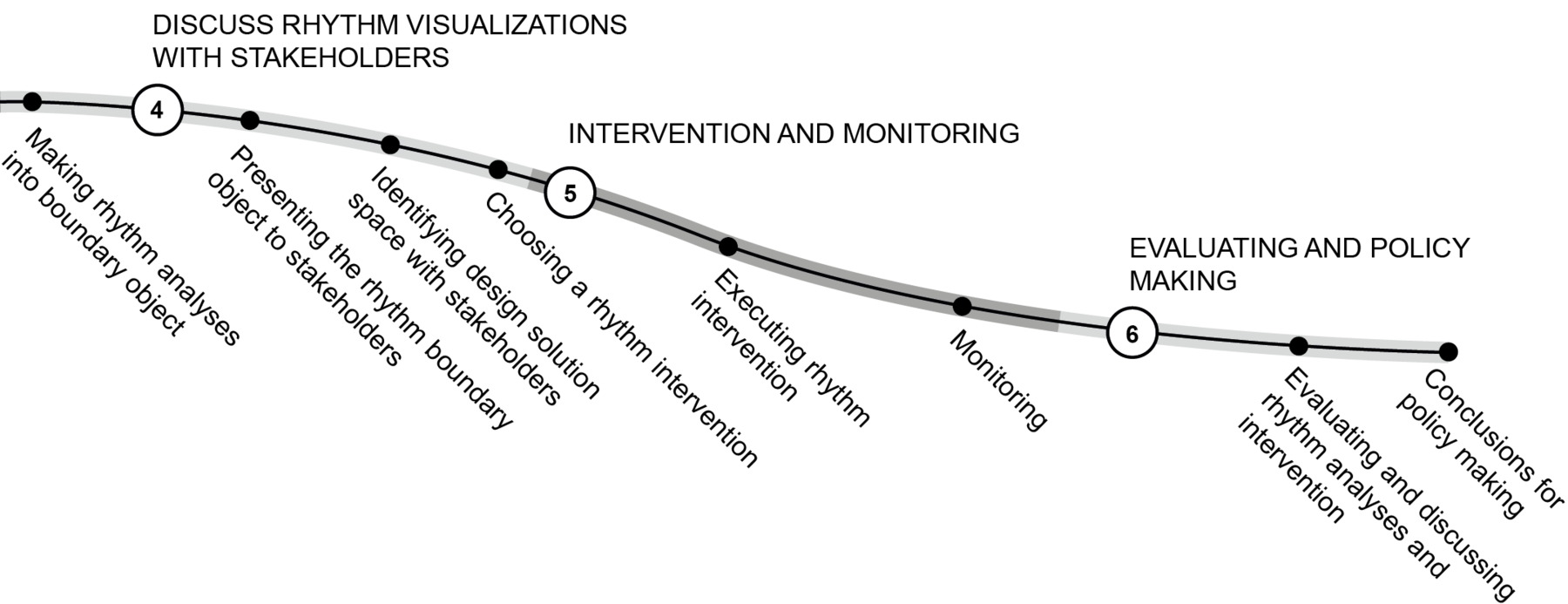
By formulating the rhythm perspective, new definitions for the social issue emerge. The rhythm perspective allows the discussion not to be focused specifically on the initial research question, but to validate many other conditions upon which this situation depends. The rhythm perspective allows for a different kind of causality to surface. As a result of this step, unexpected solution spaces emerge and a rhythm intervention can be proposed.
Following the discussions and the identification of design solution space, in the ‘Intervention and Monitoring’ step (Step 5), the proposed interventions are operationalized in collaboration with stakeholders, and their outcomes are validated from rhythm perspective. A rhythm intervention is defined here as making re-arrangements in the elements that structure earlier identified rhythms. Monitoring a rhythm intervention is to observe the performed intervention from both the social and the rhythm perspective. In the final stage, ‘Evaluating and Policy Making’, the results are evaluated from the perspective of the social issue presented and conclusions are made with stakeholders involved. In further research, a next stage for policymaking will be developed.


