Integrating Rhythms
Nature-, body- , inner- and clock- time offer rhythms that are shared and structure social life. Rhythms cannot, not integrate. This is called entrainment. During several centuries human kind developed a conscious integration of rhythms, inventing work hours, school hours, lunch breaks, agendas, holidays and more. Systems-time is challenging the integration of rhythms, since it does not seem to have a rhythm of it self. Human beings, through a methodology of trial and error, find solutions to integrate different rhythms they are confronted with. Different kinds of time merge necessarily in personal, social and collective experience of time. When working in distributed teams using technology to comunicate and collaborate, organizing a shared rhythm is crucial for keeping communication and business processes in flow. Simple things, like one well structured meeting online a week, generates trust and well being for all involved. When working in different time zones adaptation to others, at the expense of personal time, has to be taken into account. In small businesses people benefit from the fact that distributed work on a day-to-day basis facilitates personal life styles for those involved. Finding the ultimate rhythm between people’s personal time given the work that has to be done, is crucial for success.
-
ACADEMIA
Being alive
People who have died can have all sorts of presences in the variety of cultures that the human race…
-
ACADEMIA
Industrial and commercial research: to market new experiences
In the media labs of large technological corporations around the world, and especially and foremost…
-
ACADEMIA
Military research:changing scales
Military research into presence has to be mentioned here first, even though I do not intend to…
-
ACADEMIA
Monitoring physical presence
The first group of surveillance and identification technologies that I will consider is concerned…
-
ACADEMIA
Monitoring digital presence
Digital behaviour is also monitored. By gathering and analysing server information the behaviour…
-
ACADEMIA
The broad spectrum of information and communication
The broad spectrum of information and communication technologies can be divided into three groups…
-
ACADEMIA
Focus on mediation and witnessing
Below I will first make an inventory of presence technologies that exist today, dd. 2006. Then I…
-
ACADEMIA
Different scale and different media in one communication process
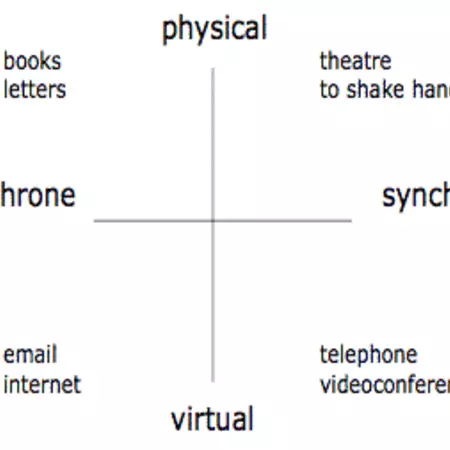
Through the use of media people try to overcome the boundaries of time and place to which our…
-
ACADEMIA
Quantative and qualitive in normative perspective
Using the text as the laboratory one does need to find cues for validity though. While writing I…
-
ACADEMIA
Doors of Perception
A last crucial influence that I will discuss in my approach and my understanding of the research…
-
ACADEMIA
Shared understanding and hard facts
In 1999 I started working for the University of Professional Education in Amsterdam and through…
-
ACADEMIA
Fundamental research in the performing arts
The staging of 'networked' performances was especially useful because fundamental issues could be…
-
ACADEMIA
Deep design
Lunenfeld argues for a deeper understanding of design from a historical and aesthetic perspective.
-
ACADEMIA
Demo or die
While I was associated and involved with Internet design over the last 15 years I observed hype…
-
ACADEMIA
'Social theory' provides context
The study "Presence and the Design of Trust" wants to explore the influence of technology on the…
-
ACADEMIA
A pragmatic perspective on trust:universal declaration of human rights
While conducting the research I found that I needed to make trust operational from the pragmatic…